
How Should Football Boots Fit: The Snug vs. Painful Line
This post contains affiliate links. As an Amazon Associate, we earn from qualifying purchases.
Football boots should fit snugly with a locked heel and a small toe gap, but never cause sharp pain or numbness. For most players, this means your true shoe size, though elite players often size down for a tighter ball feel. The right fit depends on your foot shape, the boot’s material, and the model’s specific last, a Nike Mercurial fits differently than a Nike Tiempo.
That “snug but not painful” line is the one everyone quotes, and then you lace up and wonder why your toes are numb by halftime. The disconnect usually isn’t the advice; it’s the three things the advice assumes you already know: your actual foot measurements, the boot model’s fit profile, and what the upper material will, or won’t, do over time.
What follows is a breakdown of where the sizing guides agree, where they famously disagree, and how to translate that into a pair of boots that disappear on your feet during a match.
Key Takeaways
- Start with your true shoe size for a secure fit; only consider sizing down if you’re an elite player chasing an ultra-close touch and your toes don’t curl.
- The toe gap should be minimal; sources recommend anywhere from just touching to a small gap of about half a centimetre, or 5–8 mm for engineered knit/synthetic speed boots.
- Nike states a well-fitting football boot should have no movement in the heel, while Cleats Hub notes a little heel lift (a few mm) is fine on new boots.
- Luson Sport states synthetic and TPU uppers do not stretch (only the lining loosens), while Nike says its synthetic uppers provide some room to stretch.
- If a boot causes sharp pain, numbness, or forces your toes to curl, it’s the wrong size or width, return it.
The True Size vs. Size Down Debate
Advice about football changes depending on who gives it and who hears it. The core disagreement is simple.
Nike’s official stance is that football boots should fit true to your regular shoe size. They add that elite-level athletes can size down a half or full size for a closer ball feel, but recreational players don’t need to. A retailer, euniqueboots.com, backs this up, stating plainly that most players should buy their true size, not a size up.
A recreational or amateur player doesn’t necessarily need to size down. It’s best to choose a size that feels comfortable for your style of play. . Nike Fit Guide
Yet, other sources, like a coaching aggregator, claim the opposite: “Most players take a half-size down from their everyday shoe.” So who’s right? They both are, for different people.
The “size down” advice often comes from a place of mimicking pros and chasing that coveted, sock-like connection with the ball, which is a key part of the how should football boots fit puzzle. But it assumes a narrow, low-volume foot and a high pain tolerance. For the majority of weekend warriors, sizing down is how you get black toenails. Your everyday shoe already accounts for swelling and socks; a football boot’s “true size” is supposed to be its performance fit.
| Scenario | Recommended Sizing | Why It Works |
|---|---|---|
| First-time buyer / Recreational player | True to your regular shoe size. | Prioritizes comfort and reduces injury risk from a too-tight fit. |
| Elite player with narrow feet | Can size down a half to full size. | Maximizes ball feel for players who tolerate a very snug fit. |
| Player with wider feet | True size, or even a half-size up in narrow models. | Avoids side-pinch and numbness; may need to choose a wider-fit model. |
| Buying leather boots (e.g., Copa, Tiempo) | True size, expecting a snug fit that will mould. | Leather stretches over a few sessions; synthetic does not. |
| Buying synthetic speed boots (e.g., Mercurial) | True size, must be comfortable immediately. | Material won’t give; painful new = painful forever. |
Bottom line: Use your true size as the absolute starting point. Only deviate if you have a specific, proven reason, like knowing your foot is very narrow and you’ve comfortably worn a certain model a half-size down before.
Material Truths: What Actually Stretches?
This is where hope meets engineering, and hope usually loses, especially when considering how should football boots fit over time. What you think will give way over time often doesn’t, and believing the myth is the fastest route to a boot that never feels right.
To understand this, look back at the statements. Nike states its synthetic uppers are “supple and soft and provide some room to stretch.” This is the common, comforting sales line. Then you get the factory perspective from a manufacturer like Luson Sport, which is blunt: “Synthetic and TPU uppers do not stretch. What loosens slightly is the lining, not the shell.”
That’s not a minor disagreement. It’s the difference between buying a boot that will “break in” and buying one that simply won’t.
- Leather Uppers (Calf, Kangaroo): These are the moulders. Leather stretches and shapes to your foot over time, a process that can take anywhere from a few sessions to a couple of weeks. This is why you can buy a leather boot like a Mizuno Morelia or an adidas Copa Mundial feeling just-snug, trusting it will ease into a perfect fit. The ASICS LETHAL FLASH IT 2 MENACE 4, for example, uses a Kangaroo Leather Vamp for this exact purpose.
- Synthetic & TPU Uppers: These are the stoics. They are designed to hold their shape. Any perceived “stretch” is the internal padding compressing or the laces loosening. If a synthetic boot pinches your little toe on day one, it will still pinch on day thirty.
- Knit Uppers: These are the conformists. Modern engineered knits, like on some Phantom GX models, need virtually no break-in. They wrap the foot like a sock from the first wear, conforming vertically but offering minimal lengthwise stretch.
Common mistake: Assuming a painful synthetic boot will stretch. If it’s causing sharp pain or numbness during a short try-on, it’s a fit problem. Exchange it for a different size or model.
The sensory reality here is a sound. A synthetic boot failing is a repetitive, faint creak from the same stressed spot every time you pivot.
How to Actually Measure and Try On
Forget the number on your old trainers. Your foot changes, and boot lasts vary wildly. This is the boring, essential homework.
- Measure Both Feet, Standing. Measure your feet when they are naturally swollen, which happens by late afternoon. Always fit to your larger foot. Trace them or use a wall and a ruler to get the length in centimetres.
- Wear Your Match Socks. The thickness of grip socks changes the internal volume dramatically. Trying boots on with thin dress socks is a classic error.
- Check the Toe Gap. With the boot on and laced, stand up. Your longest toe should be close to the end. Sources disagree on the exact space: a retailer recommends “just touching to a small gap of about half a centimetre,” while a community guide specifies 5–8 mm for engineered knit/synthetic boots. For leather, a thumb’s width is a common rule to allow for stretch.
- Test the Heel Lock. Your heel should be seated fully with no up-and-down movement as you walk. A “little heel lift (a few mm)” might be cited as fine in new boots, but persistent slippage will cause blisters and kill stability.
- Move and Flex. Don’t just stand there. Walk, rise onto your toes, and make a gentle cutting motion. Feel for any immediate pinch points or pressure on the sides, especially around the fifth metatarsal (little toe knuckle).
If you’re buying online, you must follow these steps. Order from a retailer with a clear returns policy, and be prepared to send back the pair that doesn’t pass this checklist.
Navigating Brand & Model Fit Profiles
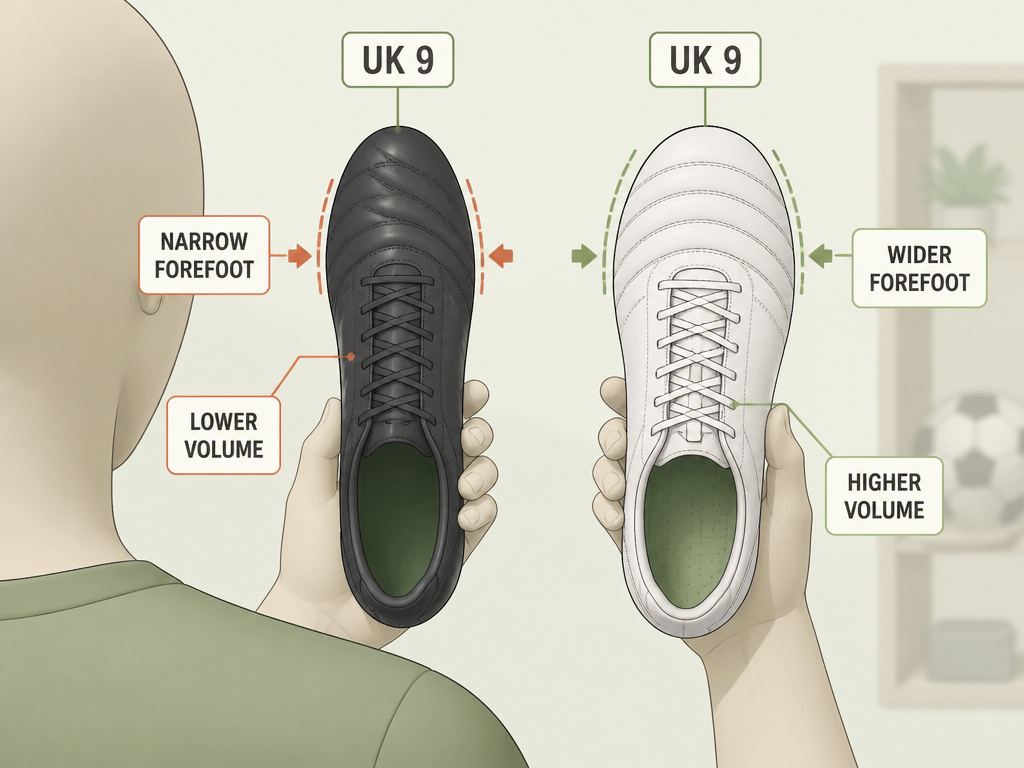
A UK 9 in one model is not a UK 9 in another. Brands build boots on different “lasts”, the foot-shaped form around which the boot is constructed, which dictate width and volume.
The Chinese national standard for football shoes, GB/T 19706-2015, is applicable to football shoes worn by athletes in competitions and training, but it doesn’t standardise fit. That’s up to the manufacturer. Here’s how some major lines typically run:
| Boot Line / Brand | Typical Fit Profile | Best For | Width Note |
|---|---|---|---|
| Nike Mercurial | Contoured, narrow, low volume. | Slim feet, players wanting a locked-in feel. | Often requires sizing up for wide feet. |
| Nike Phantom / Tiempo | Natural, wider fit. | Average to wider feet, prioritising comfort. | Tiempo’s synthetic leather is designed to mould. |
| adidas X / F50 | Slim, speed-boot fit. | Narrow, low-volume feet. | Notoriously tight in the forefoot. |
| adidas Copa / Predator | More forgiving, medium to wide. | Average foot shapes, wider options available. | Leather models (Copa) will stretch. |
| ASICS (e.g., LETHAL FLASH) | Often uses a 2E last (wider fit). | Players needing more forefoot room. | Check individual model specs for materials. |
| Mizuno Morelia | Narrow out of the box, moulds beautifully. | Players who appreciate a premium leather fit. | Must be tried on with break-in mind. |
Zoom out for a second. If you have wide feet, your shortlist should automatically include models known for roomier fits: the Nike Tiempo, adidas Copa, Puma King, and ASICS lines that specify a wider last. Forcing a wide foot into a narrow Mercurial is a recipe for discomfort.
Special Cases: Kids, Women, and Different-Sized Feet
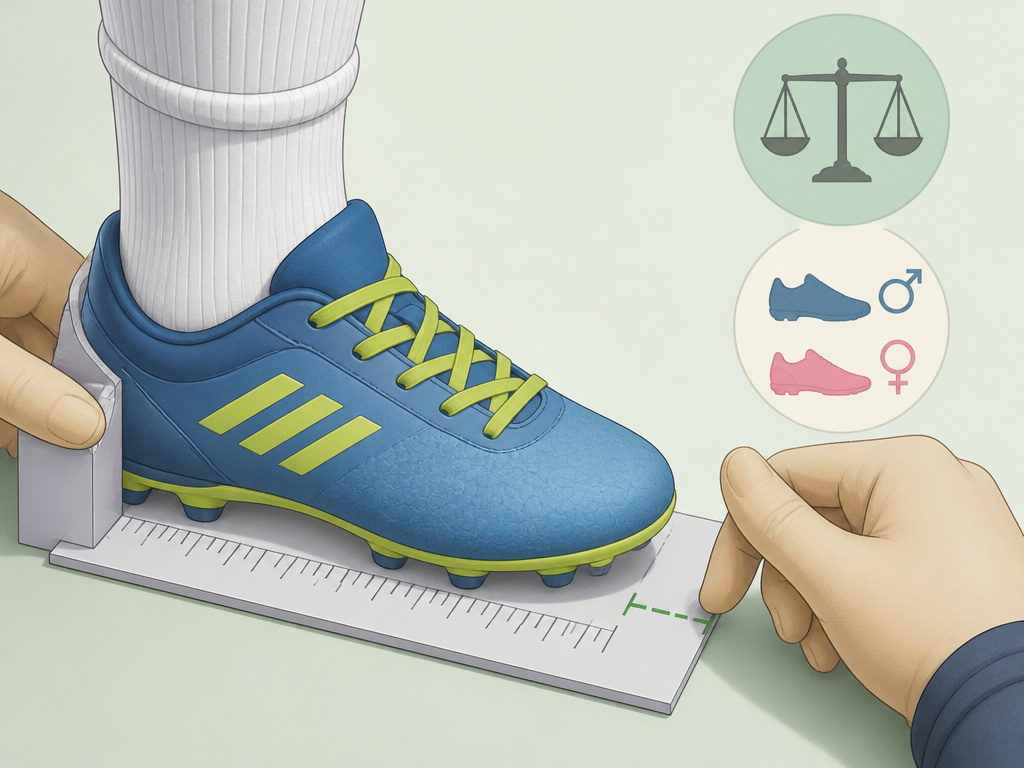
The rules bend slightly when you’re not fitting a standard adult male foot.
For Kids: The temptation is to buy big to “grow into.” Resist it. A boot two sizes up is unstable and increases injury risk. Leave a thumb-width of growing room at the toe, around a centimetre, and no more, and plan to re-measure each season. A slightly roomier fit is acceptable, but the heel must still be secure.
For Women: Sizing can be inconsistent. Nike notes that for the same boot, the equivalent Women’s UK size is the Men’s UK size + 1. However, the more critical factor is width. Standard width is D for men, B for women. If you have wider feet, you may need to explore men’s models in a smaller size or brands that offer specific wide fits.
For Different-Sized Feet: This is incredibly common. Always fit to your larger foot. For the smaller foot, you can use a thicker insole, an extra sock layer, or a padded heel grip to take up the extra volume. It’s a far easier fix than trying to stretch a boot that’s too small.
Warning Signs: When a Fit is Just Wrong
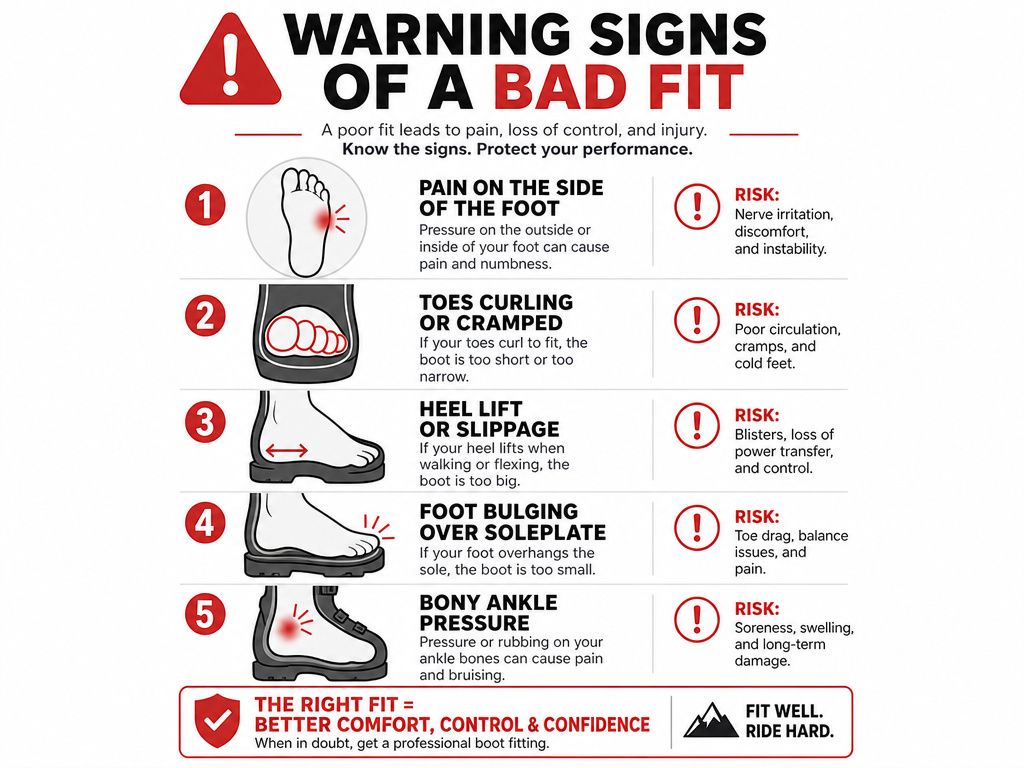
A bad fit isn’t just uncomfortable; it hampers performance and invites injury. Here’s your red-flag checklist. If you experience any of these during a try-on or first session, seriously consider an exchange:
- Sharp, Localised Pain or Numbness: Especially on the sides of the foot or toes. This indicates a width or volume issue.
- Toes Curling or Crushing: Your toes should lie flat. If they’re forced to curl to avoid the front, the boot is too short.
- Excessive Heel Slippage: More than a couple of millimetres of lift when walking. This destroys control and causes blisters.
- Foot Spilling Over the Soleplate: If your foot visibly bulges over the side of the boot’s platform, the last is too narrow.
- Pressure Points on Bony Prominences: Any spot that feels like it’s being ground against the boot’s structure.
Honestly? The biggest mistake I see is players soldiering through these pains, convinced the boot just needs to “break in.” With modern synthetics, that’s a myth. Pain is your foot telling you it’s in the wrong container.
How should football boots fit compared to regular shoes?
Football boots are designed for performance, not all-day comfort like trainers. They should feel snugger and more precise. While some guides suggest sizing down from your regular shoes for a tighter ball feel, others recommend most players start with their true shoe size. A well-fitting boot should have no movement in the heel. The upper material also dictates the feel; synthetic models may have little give, while leather will stretch and mold to your foot shape over time. Always try boots on with your football socks to get an accurate feel.
Should football boots fit for foot swelling?
Your feet will naturally swell during a match or training session. To accommodate this, a good fit anticipates the change. For this reason, you should try boots on late in the day, when your feet are at their largest. The initial fit should be snug but not painfully tight, allowing for this expansion. A boot that feels perfect when you first put it on cold may become constricting after warm-up. The goal is a secure fit that becomes optimal once you’re active, without causing discomfort or restricting circulation.
Frequently Asked Questions
Should football boots be tight or loose?
They should be snug, not tight. Snug means secure contact with no dead space, allowing for natural foot flexion and circulation. Tight means painful pressure, numbness, or restricted movement. A loose boot will cause your foot to slide, killing control and causing blisters.
How much space should be in the toe of football boots?
Small gap is needed. Recommendations vary from your toe just touching the end to a gap of about half a centimetre (5–8 mm). The key is that your toes can lie completely flat without pressing hard against the front when you stand.
Do football boots stretch?
It depends entirely on the material. Leather boots stretch and mould significantly. Synthetic and TPU uppers do not stretch in length or width; only the inner lining may compress slightly. Never buy a synthetic boot expecting it to get longer or wider.
Is heel slip normal in new football boots?
Tiny amount of initial movement might occur as the heel padding compresses, but obvious, repeated heel lifting is not normal. It usually means the boot is too long, too wide in the heel, or the last shape doesn’t match your foot. A secure heel is essential.
How do I know if football boots are too narrow?
Warning signs include immediate pinching on the sides (especially the little toe), a feeling of numbness across the forefoot, or your foot visibly overhanging the soleplate. If you need to remove the insole just to get your foot in, the boot is too narrow.
Before You Go
The perfect boot fit is a checklist, not a mystery. Start with your measured, larger foot in centimetres. Match that to a brand’s chart, not your trainer size. Focus on a locked heel and a toe box that lets your toes lie flat. Let the material guide your snugness: expect leather to give, but demand synthetic be comfortable from the first wear.
And here’s the one stance I’ll take that cuts through the noise: if you’re a recreational player, ignore the “size down” hype. Your touch comes from confidence and technique, not from suffering through a too-small boot. A secure, comfortable fit in your true size will do more for your game than any painful, professional-grade squeeze.
When in doubt, use a retailer’s return policy. A short indoor session in a clean pair tells you more than any sizing guide. Find the boot that disappears on your foot, and you’ve found the right one.
