
Types of Football Boots Explained: FG, AG, SG, TF & IC
This post contains affiliate links. As an Amazon Associate, we earn from qualifying purchases.
Firm Ground (FG), Artificial Grass (AG), Soft Ground (SG), Turf (TF), and Indoor (IC) are the five main types of football boots, each defined by its soleplate and designed for a specific playing surface. FG boots are for natural grass, AG for synthetic turf, SG for muddy pitches, TF for hard artificial surfaces, and IC for indoor courts. Wearing the wrong type accelerates wear, hurts performance, and significantly increases your risk of knee and ankle injuries.
That last point about injury risk is the one most weekend players skip. They buy a flashy pair of FG boots and wear them everywhere, from a soggy Sunday league pitch to a rock-hard 3G training ground. The studs either slip or lock in too hard, and by Tuesday their knees are clicking. The pitch is the first piece of tactical information you get before a game, and your boots are how you answer it, which is why having the different types of football boots explained matters.
What follows is a breakdown of each boot type, the surfaces they own, and the concrete consequences of getting it wrong, which is why having the types of football boots explained matters. We’ll also settle the FG-on-AG debate, walk through a simple buying rule for your first pair, and cover how to make any boot last longer.
Key Takeaways
- Match your boots to the actual surface you play on most. Using FG boots on artificial turf is the single biggest cause of premature wear and knee pain.
- For beginners or players on a budget who face mixed surfaces, a quality pair of Multi-Ground (MG) boots offers the safest, most versatile starting point.
- Screw-in studs (SG) are not recommended for young players with growing feet, per rugby safety guidance; stick with moulded soles.
- Leather boots need more care, clean off mud, air dry, and condition occasionally, while synthetics just need a wipe down.
- Replace boots when studs are visibly rounded or the upper splits; a loose fit that causes heel slip is a safety issue, not just a comfort one.
The Five Main Boot Types and Their Surfaces
Minute one, kickoff. Your first touch tells you everything about the pitch. Is it firm, soft, synthetic, or bone-dry? Your boots should already know the answer.
This isn’t about marketing; it’s about the physics behind the types of football boots explained. The soleplate is a tool for transferring force between your foot and the ground. The wrong tool breaks, sometimes it’s the boot, sometimes it’s your ligaments.
The simple rule is to match the stud to the surface. Firm-ground studs on soft, wet grass leave the player slipping. Soft-ground metal studs on a dry, hard pitch transfer too much force into the player’s joints.
Firm Ground (FG) – The Default for Natural Grass
FG boots are the standard. They’re designed for natural grass pitches that are in good condition, not waterlogged, not sun-baked hard. The soleplate uses moulded plastic studs designed for traction and release on firm natural grass.
The studs are long enough to penetrate the turf and give you grip, but they’re designed to release cleanly when you pivot. That clean release is what prevents your foot from getting stuck, a common cause of non-contact knee injuries.
Where this goes sideways: Using FG boots on modern artificial grass (3G/4G). The longer studs can dig into the rubber infill and “lock” your foot during a turn. That rotational stress doesn’t just strain your knee; it also accelerates wear on the soleplate. Cleats Hub notes that using FG repeatedly on artificial turf can even void manufacturer warranties.
Artificial Grass (AG) – Built for the Modern Pitch
AG boots are for synthetic turf, the 3G and 4G surfaces you find at most modern training facilities and public parks. The soleplate is packed with many shorter studs made from hard rubber or plastic.
The design has two jobs. First, the higher stud count spreads the pressure of your footstrike across a wider area, reducing the point load on any one part of your foot or knee. Second, the shorter length prevents excessive penetration and stud-lock, allowing your foot to rotate more naturally on the unforgiving surface.
Soft Ground (SG) – For the Wet and the Muddy
SG boots are your wet-weather specialists. They’re for natural grass pitches that are soft, muddy, or heavily watered. They traditionally feature longer studs, often metal and screw-in, that dig deep to find solid ground underneath the slop.
The metal provides bite where plastic would slide. For rugby forwards who need immense traction in the scrum, the Sports Trader document states: screw-in studs are preferred. For football, they’re a situational tool. You wouldn’t use them every week, but when the conditions turn, they’re the difference between keeping your feet and spending the afternoon on your back.
Common mistake: Using SG boots on artificial turf or hard ground. The long metal studs have nowhere to go on a hard surface, so all the impact shoots straight up your leg. It’s uncomfortable, dangerous for your joints, and most facilities ban them outright.
Turf (TF) & Indoor (IC) – For Courts and Halls
These are for non-grass surfaces. TF boots (sometimes called Astros) have dozens of small, rubber nubs for short-pile artificial turf or hard, compacted outdoor areas. They provide grip through friction, not penetration.
IC boots are for indoor courts, flat, non-marking rubber soles designed for sports halls and futsal. They offer grip while protecting the floor. Trying to wear studded boots indoors is a sure way to roll an ankle and get a telling-off from the caretaker.
| Boot Type | Primary Surface | Stud Key Features | When You Absolutely Shouldn’t Use It |
|---|---|---|---|
| Firm Ground (FG) | Natural Grass (dry/firm) | Moulded plastic, medium length | On artificial turf (injury & wear risk) |
| Artificial Grass (AG) | Synthetic Turf (3G/4G) | Many short, often hollow studs | On deep, muddy natural grass (no traction) |
| Soft Ground (SG) | Natural Grass (wet/muddy) | 6 long, often metal screw-in studs | On hard ground or artificial turf (joint impact) |
| Turf (TF) | Short-pile turf / hard ground | Many small rubber nubs | On soft, natural grass (will slip) |
| Indoor (IC) | Sports halls / courts | Flat, non-marking rubber sole | On any outdoor surface (no grip) |
The FG vs AG on 3G Debate – And Why It Matters
Here’s the bit people skip. You’ll see plenty of players wearing FG boots on artificial grass. Some manufacturers even label certain models as “FG/AG.” So what’s the real rule?
The sources disagree, which tells you the answer isn’t simple. One retail guide states it’s not recommended to use any boot other than a specific AG stud configuration on artificial grass. Another source says some moulded FG designs are permitted on 3G, depending on the manufacturer and pitch.
Let’s rewind the tape. The core issue is stud-lock, the feeling that your foot is stuck when you try to turn. Modern systematic reviews find that overall injury rates are similar between modern artificial turf and natural grass, though a common perception persists that artificial turf is inherently more dangerous. But using the wrong studs changes that calculus. FG studs, especially aggressive blades, are more likely to grab the synthetic fibres too firmly.
I leaned on the “one-boot-fits-most” idea for years. Then I spent a preseason training on 3G twice a week in my old FG boots. By the third week, a dull ache settled behind my kneecaps that didn’t fade until I switched to a dedicated AG pair. The boots were fine on grass, but the surface was the boss.
The practical verdict: If you play mainly on 3G, buy AG boots. They are engineered for the surface. If you split time evenly between good grass and 3G, a hybrid Multi-Ground (MG) boot or a manufacturer-approved FG/AG model is a sensible compromise. But if your club’s rules specify AG or TF only, follow them. Their insurance likely depends on it.
Boot Materials, Fit, and Making Them Last
The soleplate talks to the ground. The upper talks to the ball and your foot. Getting both conversations right is how you play better, longer.
Leather vs. Synthetic Uppers
This is a classic touch versus technology trade-off.
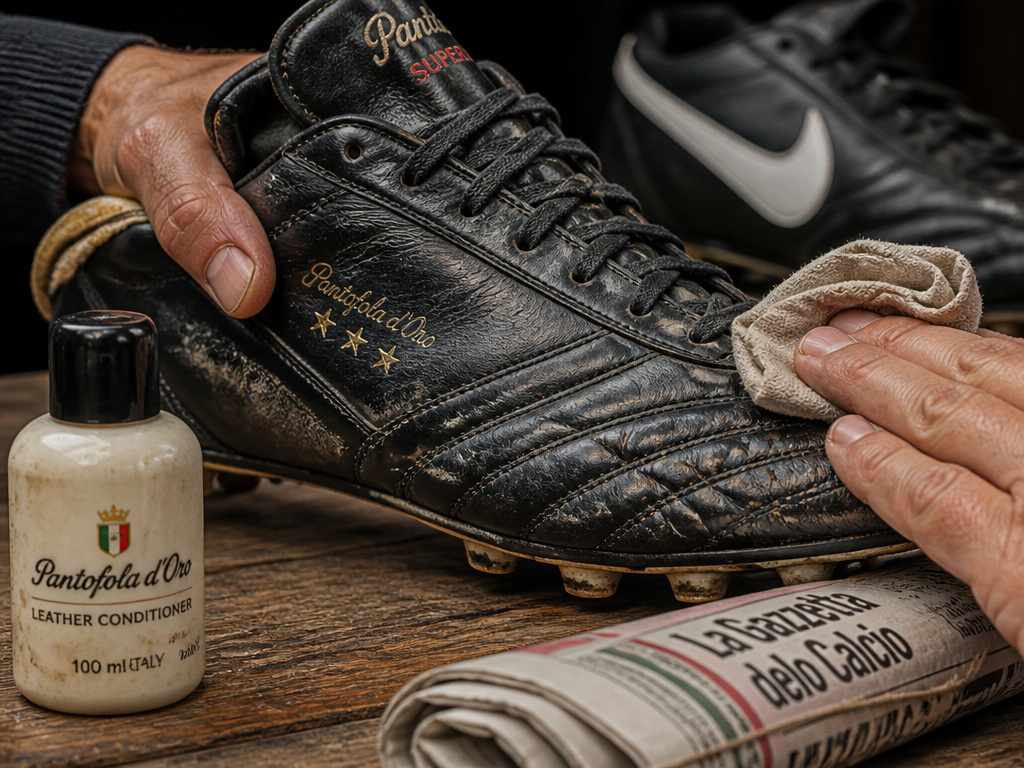
- Leather (like the Adidas Copa or Mizuno Morelia): Moulds to your foot for a custom fit, offers a sublime, soft feel on the ball. The downside? It’s heavier when wet, stretches over time, and needs looking after. You must clean off mud, let them air dry at room temperature (never on a radiator), and use a conditioner occasionally.
- Synthetic: Lighter, more water-resistant, and doesn’t stretch. Modern synthetics mimic leather feel well. Maintenance is easier, wipe off dirt and store them away from direct sun and heat.
There’s no “best” material. Do you value a glove-like fit and traditional feel, or consistent performance with less hassle? Your foot and your routine decide.
How Should Football Boots Actually Fit?
A boot that’s too big is as bad as one that’s too small. You need a snug, sock-like fit with no heel slip and your toes close to, but not jammed against, the front.
- Measure both feet and fit the larger one.
- Try boots on in the afternoon when your feet are naturally swollen.
- Wear the socks you play in. A thin training sock and a thick match sock create different volumes.
- Account for width. Some boots, like many speed models, run notoriously narrow. Classics and control-oriented models often tend to be more forgiving in width.
If you’re unsure, our dedicated guide on how football boots should fit walks through the heel-lock test and toe-room check.
Care and Knowing When to Retire Them
Boots are a consumable. They don’t last forever, but you can extend their life.
- Clean them after use. Knock off mud, wipe synthetic uppers, gently brush leather.
- Dry them naturally. Stuff them with newspaper to absorb moisture from the inside out. Never force-dry with heat.
- Rotate pairs if you can. Having a dedicated training pair (often AG or TF) and a match pair saves both from daily abuse.
- Inspect the studs and upper. Replace them when:
- The studs are visibly worn down or rounded.
- The upper material splits or tears.
- The fit becomes too loose, causing your heel to slip during runs, this is a stability hazard.
A split upper isn’t just ugly; it’s a structural failure. Time for a new pair.
A Simple Guide to Your First (or Next) Pair
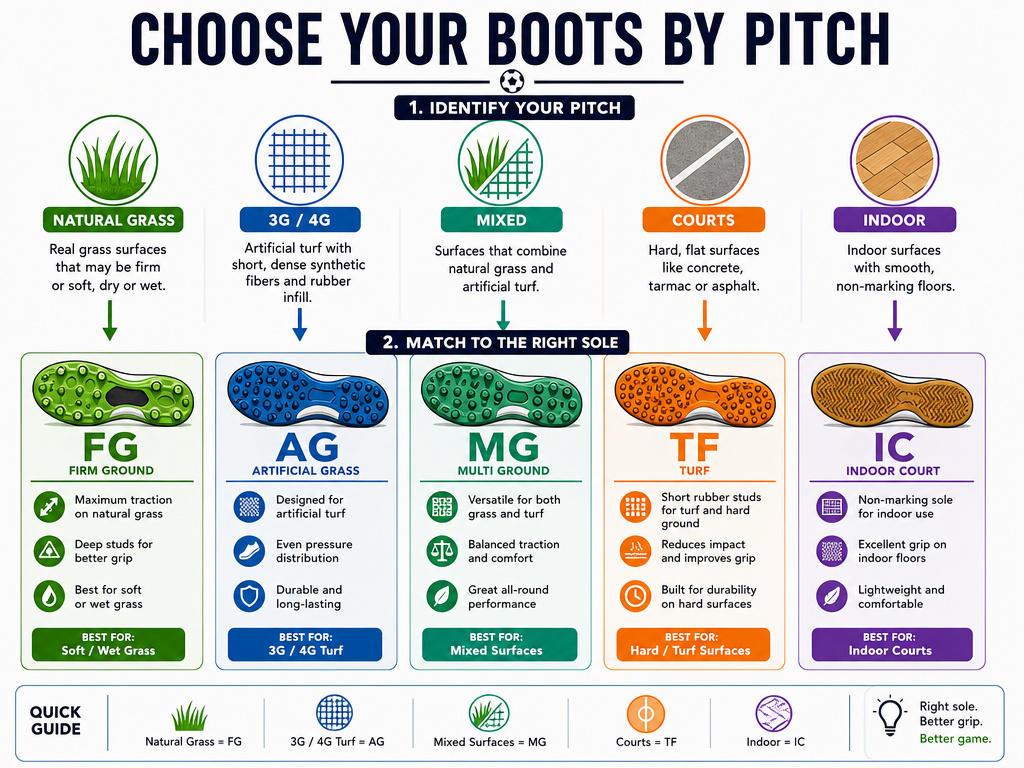
Zoom out for a second. With all these acronyms, buying boots can feel overly complex. This can be simplified into a decision tree based on the most important factor: your primary pitch.
If you play mostly on…
- Natural grass (and can afford two pairs): Get FG boots for normal conditions and SG boots for the winter mud.
- Modern 3G/4G artificial turf: Get AG boots. Full stop.
- A mix of grass and artificial turf: Get MG boots or a manufacturer-approved FG/AG hybrid.
- Hard courts or astroturf: Get TF boots.
- Indoor halls: Get IC boots.
For young players, prioritise moulded studs over screw-ins for safety and growth room. And always, fit trumps brand. A perfectly fitting budget boot will always beat an ill-fitting elite model.
What do boot performance tiers mean?
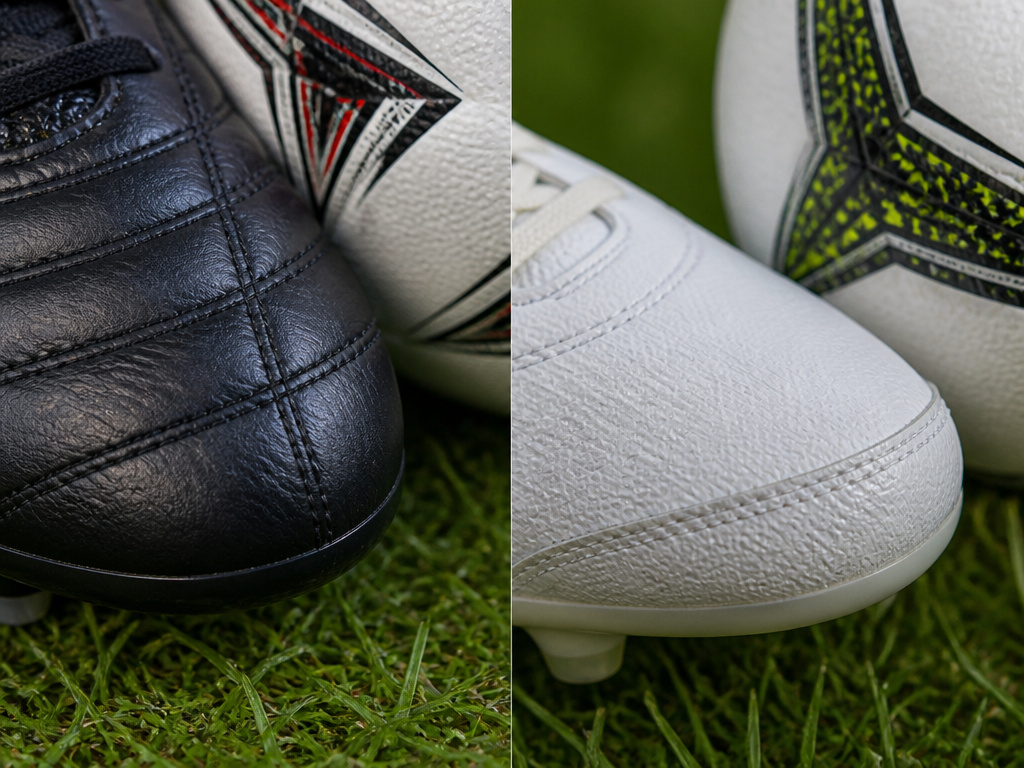
Performance tiers reflect the materials, technology, and weight built into a boot, directly impacting feel and durability. Higher-tier models often use more advanced synthetic materials or premium leathers for a better touch, alongside lighter, more responsive soleplates. These differences translate to a more connected feel to the ball and the pitch. Lower-tier versions use more durable, often heavier materials to offer a similar look at a lower cost, but with a stiffer break-in and less refined touch. The choice depends on your level of play and how much you value that precise, lightweight sensation versus overall durability and budget.
Which boots are best for speed or control?
Boots are engineered to enhance specific attributes, with design focusing on the upper and the sole. For speed, choose a lightweight, thin synthetic upper and a low-profile stud configuration that minimizes weight and promotes a sprinting posture. Control-focused boots prioritize a padded, often leather or textured synthetic upper for maximum cushioning and grip when receiving or striking the ball. The soleplate also plays a role; a more rigid plate can aid power, while a flexible one aids natural movement. Your position and how you interact with the ball should guide your choice between a boot built for pace or one built for touch.
Frequently Asked Questions
What are the three main types of football boots?
The three core types for outdoor grass are Firm Ground (FG), Soft Ground (SG), and Artificial Grass (AG). FG is for standard grass, SG for wet/muddy grass, and AG for synthetic turf. Turf (TF) and Indoor (IC) boots cover other surfaces.
What does FG, SG, and AG mean?
These are abbreviations printed on the soleplate. FG stands for Firm Ground, SG for Soft Ground, and AG for Artificial Grass. Each denotes the specific playing surface the boot’s stud pattern is engineered for.
What is better, AG or FG?
Neither is universally “better.” AG boots are better for artificial grass pitches because they reduce stud-lock and knee stress. FG boots are better for natural grass pitches because they provide the right traction and release. Choose based on your primary surface.
What type of football boots should I get?
Start with your most common playing surface. If it’s grass, get FG boots. If it’s synthetic turf, get AG boots. If you play on both equally, look at Multi-Ground (MG) boots as a versatile single-pair solution. Always prioritize a snug, proper fit above any specific technology.
Can I wear Firm Ground boots on artificial turf?
You can, but you shouldn’t make a habit of it. It increases wear on the boot, can void the warranty, and raises your risk of knee and ankle injuries due to excessive rotational stress. For regular play on artificial turf, dedicated AG boots are the right tool for the job.
Before You Go
The right boot doesn’t score goals for you. But the wrong boot can definitely stop you from playing the next one. This whole conversation boils down to respecting the surface you’re on and listening to what your boots, and your body, tell you after a match.
If you take one thing, let it be this: before your next game, look at the pitch. Really look at it. Is it the hard, black rubber of a 3G field or the soft, giving mud of a November park? Then look at your boots. That’s the only comparison that matters. Everything else is just noise.
