
Astro Turf vs Indoor Football Shoes: Which Should You Buy?
This post contains affiliate links. As an Amazon Associate, we earn from qualifying purchases.
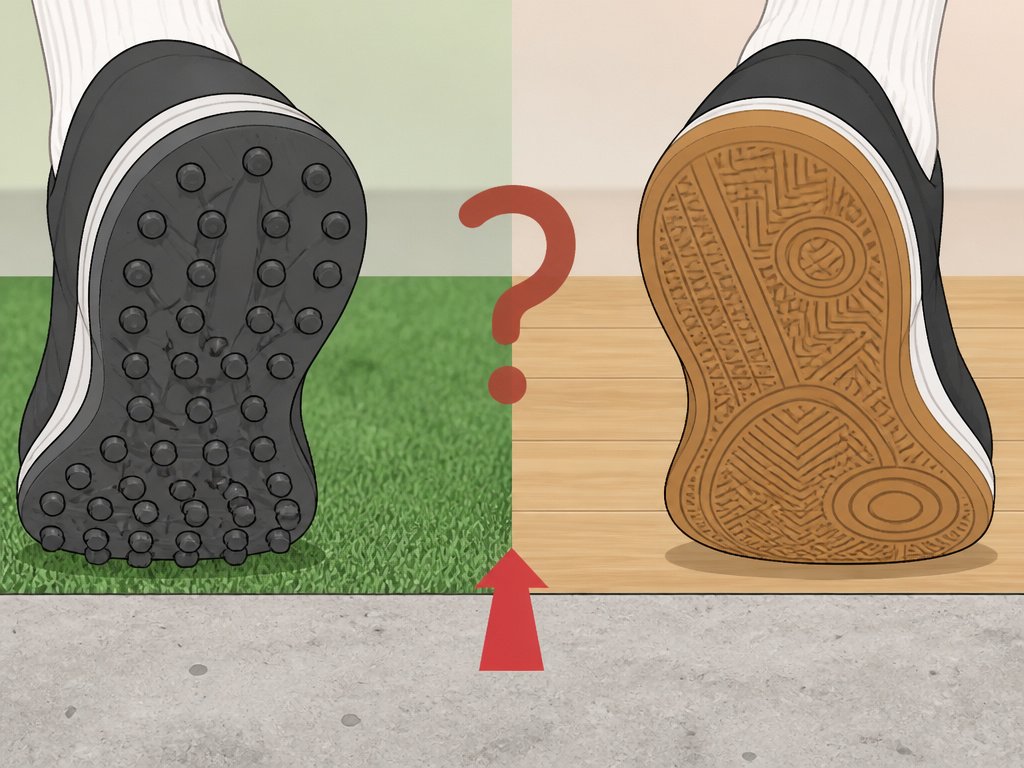
Astro turf (TF) football shoes have many short rubber studs for grip on synthetic grass and hard, worn pitches. Indoor (IC/IN) shoes have a completely flat, non-marking gum rubber sole for traction on smooth, sealed courts like gyms and futsal halls. They are not interchangeable. Using turf shoes on a court offers poor grip and marks the floor; using indoor shoes on turf shreds the sole and risks injury.
The divide comes down to the rubber under your foot. Turf rubber is hard and abrasive-resistant to survive synthetic blades. Indoor gum is soft and tacky to stick to polished wood. The key difference in astro turf vs indoor football shoes is this rubber compound. The wrong compound fails fast.
What follows: a breakdown of the two soles, the surfaces they’re built for, the specific risks of swapping them, and how to read a venue’s floor before you buy.
Key Takeaways
- Match the sole to the surface first. Turf shoes (TF) for artificial grass; indoor shoes (IC/IN) for smooth, sealed courts. Your performance and safety depend on it.
- The rubber compound is the real divider. Turf outsoles use hard, marking rubber that scuffs floors. Indoor outsoles use soft, non-marking gum that grips courts but wears fast on turf.
- They are not versatile cross-trainers. Using turf shoes indoors often leads to a ban from venues. Using indoor shoes on turf can cause injury and destroys the shoe.
- “Indoor” can mean two things. In North America, it often means short-pile turf inside a dome (use TF shoes). Everywhere else, it means a hard court (use IC/IN shoes).
- For true multi-surface play, look for a hybrid street/indoor model like the Cruyff RE Astro, designed for asphalt and courts, not for turf.
The Sole Difference: Studs That Grip vs. Rubber That Sticks
Minute five of a match on a new 3G pitch, and your feet feel planted on every turn. That’s the turf sole working. It’s not just about the studs you see; it’s about the rubber formula you can’t read at a glance.
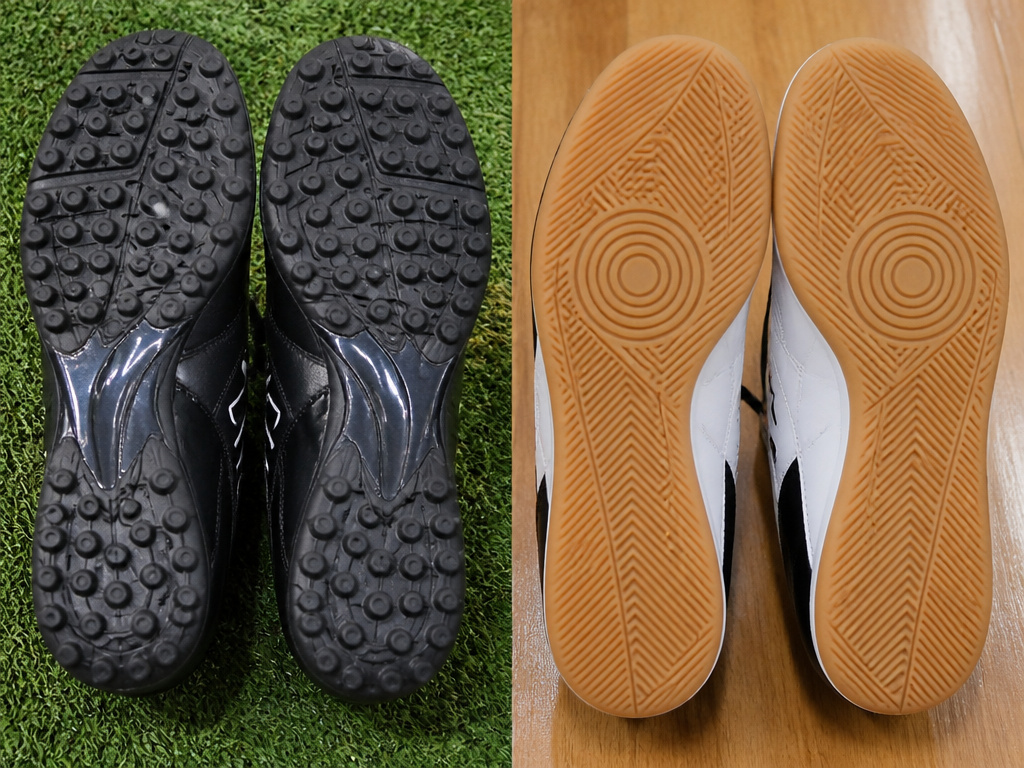
Turf shoes have a flat base covered in dozens of short, hard rubber studs. The Loughborough University sports surface study identified that relatively short and evenly distributed stud configurations provide good functional traction on certified artificial turf. The rubber is compounded to be abrasion-resistant because synthetic blades chew through anything soft.
Indoor shoes are the opposite. They have a completely flat, smooth gum rubber sole. The rubber is softer and tackier, formulated for maximum friction on polished floors. It’s also non-marking — a hard requirement for most indoor venues to protect their surfaces.
Turf (TF) outsoles use a harder, abrasion-resistant rubber compound with many short studs for artificial turf. Indoor (IC/IN) outsoles use a softer, tackier, non-marking gum rubber in a completely flat profile for sealed courts.
The studs on a turf shoe are there to penetrate and release from the turf carpet’s infill. On a slick court, those same studs reduce the rubber’s contact area with the floor. You’re standing on dozens of tiny points instead of one solid sheet, a core issue in the astro turf vs indoor football shoes debate. The result is a skating sensation on sharp cuts.
Built for the Battle: Surface-Specific Design
Look at the two shoes edge-on. A turf shoe generally sits a touch taller, with a bit more material between your foot and the ground. That extra stack is cushioning for the hard, unyielding surface of older turf pitches or concrete-based carpets.
An indoor shoe sits lower and flatter. This isn’t a flaw. The thin profile trades cushioning for court feel and stability, letting you feel the floor for quicker direction changes. This design is why the best indoor soccer shoes prioritize a barefoot-like connection to the surface.
The uppers follow suit. Turf shoes often have more reinforced overlays in high-wear areas to handle the abrasive nature of artificial grass. Indoor uppers lean toward lightweight synthetics or soft leathers for better ball feel, as seen in models like the PUMA ULTRA PLAY Indoor or the adidas F50 League Indoor.
| Feature | Turf Shoes (TF) | Indoor Shoes (IC / IN) |
|---|---|---|
| Outsole Design | Many short rubber studs on a flat base | Completely flat, smooth gum rubber |
| Rubber Compound | Harder, abrasion-resistant | Softer, tackier, non-marking |
| Profile / Stack Height | Slightly higher, more cushioning | Low and thin for court feel |
| Built For | Artificial turf and hard, worn pitches | Sealed indoor courts and futsal halls |
| Key Weakness | Studs skate on smooth floors; marks surfaces | Gum shreds fast on abrasive turf |
Where This Goes Sideways: The High Cost of Mismatching
I learned this the hard way watching a youth team’s pre-season. Their budget was tight, so the coach bought one bulk order of what he thought were versatile “indoor” shoes. The problem? Their “indoor” facility was a dome with a short-pile turf carpet. By the third training session, the soft gum soles were visibly fraying at the edges. Two players tweaked ankles on cuts where the shoes simply didn’t grip.
The risks are concrete and documented.
Common mistake: Using indoor shoes on turf. The soft gum rubber cannot withstand the abrasion. It wears down rapidly, and the flat sole cannot effectively penetrate the turf carpet, leading to slippage and potential knee or ankle injury.
The reverse is just as problematic. Turf shoes on a court are often banned outright. The hard rubber studs scuff and streak polished hardwood or synthetic floors. Beyond the damage, the studs offer poor grip. As dust collects in the grooves during a game, traction drops even further. You become a liability to the floor and to your own stability.
This isn’t theoretical disagreement. Sources clash directly on cross-use. Sources disagree on this: Kit Queen suggests turf trainers are versatile and can be used indoors with less grip, while Luson Sport and major brands state they are not interchangeable and increase injury risk. When a venue’s rules and a manufacturer’s warning align, you have your answer on the astro turf vs indoor football shoes question.
Navigating the “Indoor” Confusion and Hybrid Surfaces
The terminology used in soccer isn’t the same everywhere. In North America, “indoor soccer” often refers to games played on short-pile artificial turf inside a dome or arena. For that surface, you need turf (TF) shoes. True “indoor” shoes, as defined by the acronym IC or IN, are for hard courts.
This is a critical distinction. If you’re shopping for shoes for indoor turf, you are looking for turf shoes. If you’re playing futsal on a gym floor, you need indoor soccer shoes. Our surface comparison guide dives deeper into other categories like FG and AG.
What about concrete, asphalt, or a textured outdoor court? These are hybrid surfaces. Most standard turf or indoor shoes are not ideal here. Turf studs grind down on concrete; indoor gum shreds. For street soccer or multi-surface play, a few models are explicitly designed for it. The Cruyff RE Astro, for example, is marketed for “indoor/street” use, with a durable outsole meant for asphalt and courts — not for turf.
The One-Shoe Compromise and What to Actually Buy
Can you buy one pair for everything? Honestly, no. Not if you want performance, safety, and your shoes to last. The engineering trade-offs are too fundamental. A sole hard enough for turf is wrong for a court. A sole soft enough for a court dies on turf.
Your buying decision should start with a simple audit: what surface do you play on 80% of the time? Buy the shoe for that surface. If you split time evenly between a turf pitch and a futsal court, you need two pairs. It’s cheaper than one emergency room visit or replacing destroyed shoes every season.
Most players on artificial grass need a specific pair of turf soccer shoes. For the hardcourt player, a quality pair of indoor shoes for men or women with a proper non-marking sole is the baseline. Ignore marketing about versatility. Look for the TF or IC/IN label on the box, then check the rubber.
Where most people get wrong: Prioritizing brand or ultra-light weight over the sole designation. A mid-range shoe with the correct TF or IC sole will always outperform a top-end shoe built for the wrong surface.
The official football federation equipment guide reinforces this: surface-specific footwear isn’t a suggestion; it’s a core part of equipment safety. Your boots are your primary point of contact with the game. Get that connection right.
Frequently Asked Questions
Can I wear astro turf trainers indoors?
You can, but you shouldn’t. Turf trainers have hard rubber studs that mark and scuff indoor floors, which is why many venues ban them. More importantly, the studs offer poor grip on smooth surfaces, increasing your risk of slipping and injury. They are not a safe or appropriate choice for indoor court play.
Are indoor football shoes the same as turf shoes?
No. They are built for opposite surfaces. Indoor shoes have a flat, non-marking gum rubber sole for sealed courts. Turf shoes have a studded, hard rubber sole for synthetic grass. The materials, design, and intended use are completely different. Our explanation of boot types covers this in detail.
Is it okay to wear indoor shoes on astro turf?
No. Using indoor shoes on turf is discouraged by many manufacturers and sources, though some note they can technically be used but are not ideal. The soft gum rubber wears down extremely quickly on abrasive turf, and the flat sole cannot penetrate the surface for secure traction. This combination leads to accelerated shoe damage and a higher risk of ankle or knee injuries from slipping.
What if I play on both surfaces regularly?
You need two pairs of shoes. There is no one sole that optimally grips both a hard court and an artificial turf pitch without compromising safety, performance, or durability. Invest in a pair of shoes for artificial grass and a separate pair for indoor courts. Your knees and your wallet will thank you in the long run.
The Bottom Line
The choice between astro turf and indoor football shoes isn’t about preference. It’s about physics. A studded sole grips turf; a flat sole grips court. The wrong one fails.
If you only remember one rule, let it be this: find the two-letter code on the shoe or the box. TF for turf. IC or IN for indoor. Everything else — weight, color, brand hype — is secondary. Match that code to your pitch, and you’ve solved 90% of the problem. The other 10% is just tying your laces.
