
Football Boot Stud Types Explained: The Surface Science
This post contains affiliate links. As an Amazon Associate, we earn from qualifying purchases.
Football boot stud types are categorized by shape (conical, bladed, hybrid), construction (moulded or screw-in), and are engineered for specific surfaces: Firm Ground (FG), Soft Ground (SG), Artificial Grass (AG), and Turf (TF). The right choice is a safety decision, not just a performance one. A 2023 study found boots with just six studs are contraindicated on AG due to high impact peaks, while using SG screw-ins on firm surfaces concentrates pressure through 6-8 points, raising ankle sprain risk.
That last point about pressure is where the generic advice stops. The difference between a safe choice and a safe one isn’t about marketing categories; it’s about how your weight gets from your foot to the ground. Get that transfer wrong, and the stud pattern becomes a hazard. A guide to football boot stud types explained this principle in detail.
What follows is a breakdown of the codes, the shapes, and the biomechanics the manufacturers don’t put on the box, essentially the football boot stud types explained. We’ll look at what the lab tests say about traction, which stud layouts are linked to foot and ankle injuries, and why the most common stud shape might not be the best for the pitch you play on.
Key Takeaways
- Match the boot category to your primary surface (FG, SG, AG, TF). Using SG screw-ins on firm ground concentrates body weight through just 6-8 pressure points, leading to blisters and a higher platform that increases ankle sprain risk.
- On artificial grass, avoid boots with a low stud count. Research in the International Journal of Environmental Research and Public Health states boots with six studs generate considerable impact peaks and their use is contraindicated on this terrain.
- Stud shape affects injury risk, not just grip. A 2020 biomechanical study found knife-shaped studs create higher peak pressure on the lateral forefoot, raising the risk of fifth metatarsal injury during cuts, while triangular studs showed good explosive force for quick direction changes on turf.
- Moulded studs (fixed to the soleplate) are for predictable surfaces like firm ground or AG. Screw-in studs (removable metal or plastic) are for soft, muddy pitches where longer length (up to the 21 mm legal maximum) is needed for penetration.
- Boot fit is foundational. A poorly fitted boot alters your gait and how studs engage with the surface, negating any pattern’s benefits. Start with a well-fitted boot, then choose your pattern.
The 5 Surface Codes: FG, SG, AG, TF, MG
Think of these codes as a manufacturer’s shorthand for “this is where this tool works,” a core part of the football boot stud types explained. Ignoring them is like using a wrench as a hammer, you might get a result, but the method is flawed and something will likely break.
Firm Ground (FG) boots are the default for natural grass pitches in good condition. According to the Sydney Physio Clinic, their moulded rubber or plastic studs are typically 10–12 mm long at the heel, shorter at the forefoot. World Rugby sets a maximum legal stud length of 21 mm. The pattern uses a multi-stud formation to distribute impact load. The goal is reliable grip with a clean release to avoid the foot sticking, a known mechanism for non-contact knee and ACL injuries.
Soft Ground (SG) boots are for wet, muddy, or deeply grassed pitches. They feature fewer, longer, often metal screw-in studs (usually a 6-8 stud formation) that can penetrate soft turf. These studs can be up to the 21 mm maximum length set by World Rugby’s equipment specifications. The advantage is deep traction in slop. The massive disadvantage, as noted by sports physio clinics, comes if you use them on a firm surface where they can’t sink in: your entire body weight funnels through those 6-8 points.
Where this goes sideways: Using screw-in SG boots on a firm or hard surface. The studs don’t penetrate, creating an elevated, unstable platform. This concentrates force, causing blood blisters under the ball of the foot or fat pad irritation on the heel, and significantly increases the risk of an ankle sprain from a slight roll.
Artificial Grass (AG) boots are engineered for modern synthetic pitches. They have numerous short, rubbery moulded studs. The design prioritizes pressure distribution on a surface that is inherently less forgiving than natural grass. A 2023 study was blunt: boots with six studs “generate considerable impact peaks” on AG and “their use is contraindicated on this type of terrain.” More studs, shorter length.
Turf (TF) or “indoor” boots are for hard, short-pile artificial surfaces or indoor courts. The sole is designed for multi-directional grip and cushioning on unyielding ground. It’s all about multi-directional grip and cushioning on unyielding ground.
Multi-Ground (MG) is a hybrid category, offering a conical stud pattern that manufacturers claim works on FG, AG, and dry SG. It’s a compromise, better than wearing FG on AG, but not as optimized as a dedicated AG boot for that surface.
| Surface Code | Best For | Stud Key Features | Risks of Misuse |
|---|---|---|---|
| FG (Firm Ground) | Well-maintained natural grass | 10-12 mm moulded studs, multi-stud pattern | Sticking on AG, poor penetration on soft mud |
| SG (Soft Ground) | Wet, muddy, deep grass pitches | Fewer (6-8), longer (up to 21mm) screw-in studs | Ankle sprains, foot pain on firm ground |
| AG (Artificial Grass) | 3G/4G synthetic pitches | Many short, rubber moulded studs (20+) | High impact forces, joint strain if using FG/SG |
| TF (Turf) | Hard artificial surfaces, indoor | Rubber matrix with many tiny studs | Slipping on natural grass, lack of cushion on hard ground |
| MG (Multi-Ground) | Mixed surfaces (FG/AG) | Conical, often blunted moulded studs | Not optimal for very soft or very hard extremes |
Stud Shape Showdown: Conical, Bladed, and Hybrid
Once you’ve picked your surface, the stud shape fine-tunes the interaction. This is where personal preference and position-specific needs come in, backed by some surprising lab data.
Conical studs are the traditional round or ovoid shape. They’re the most common, making up 57.8% of studs in a 2023 sample. The rounded edges promote smoother rotational release. A 2020 study on artificial turf found round studs produced the minimum peak vertical ground reaction force, which translates to less shock traveling up the leg with each step.
Bladed studs are thin, rectangular plates. They offer a larger surface area for pushing off in linear movements (sprinting) and are favored by many for their perceived “bite” on firm ground. However, that same bite can be a liability. The sharp edges can dig in and resist rotation more than a conical stud, which some biomechanists link to higher torsional forces on the knee.
Hybrid/Chevron studs combine shapes, often with conical studs at the rear for stability and bladed or triangular studs in the forefoot for traction. Research points to benefits here. A 2024 traction study found that the increased contact area of chevron studs led to a higher traction coefficient on natural grass compared to standard FG conical (FGC) boots.
The different stud shapes of firm ground soccer shoes have little effect on the traction force. Knife stud has a higher risk of fifth metatarsal bone injury. The triangle stud shows good explosive force and provides the ability to change direction quickly. From a 2020 biomechanical study on stud shape effects
Here’s the interesting conflict. While that study concluded shape has little effect on pure traction, it found dramatic differences in load distribution. Knife-shaped studs created higher peak pressure on the lateral forefoot (5th metatarsal region) during cutting movements, tagging them with a higher injury risk for that specific bone. Meanwhile, triangular studs showed “good explosive force” for quick direction changes.
So the choice isn’t just grip. It’s about how force is channeled through your foot.
Moulded vs. Screw-In: Construction Matters
The way studs are attached defines the boot’s flexibility and purpose.
Moulded studs are fixed, part of the soleplate from manufacture. They’re lightweight, durable, and the standard for FG, AG, and TF boots. You’re trading the ability to customize length for consistency and a design where the stud pattern and sole flexibility are engineered as one unit. When they wear down, you can sometimes find replacement studs for specific models, but often the boot is simply replaced.
Screw-in studs are removable, threading into receptacles in the soleplate. This is the domain of SG boots. They allow you to replace worn studs, mix stud lengths (e.g., longer at the heel for forward drive), or swap to metal-tipped studs for extreme soft ground. The process for changing studs is simple with the right tool, but it requires checking tightness regularly. The trade-off is weight and complexity, and the critical warning about using them on the wrong surface.
The Injury Science: What Stud Patterns Can Cause
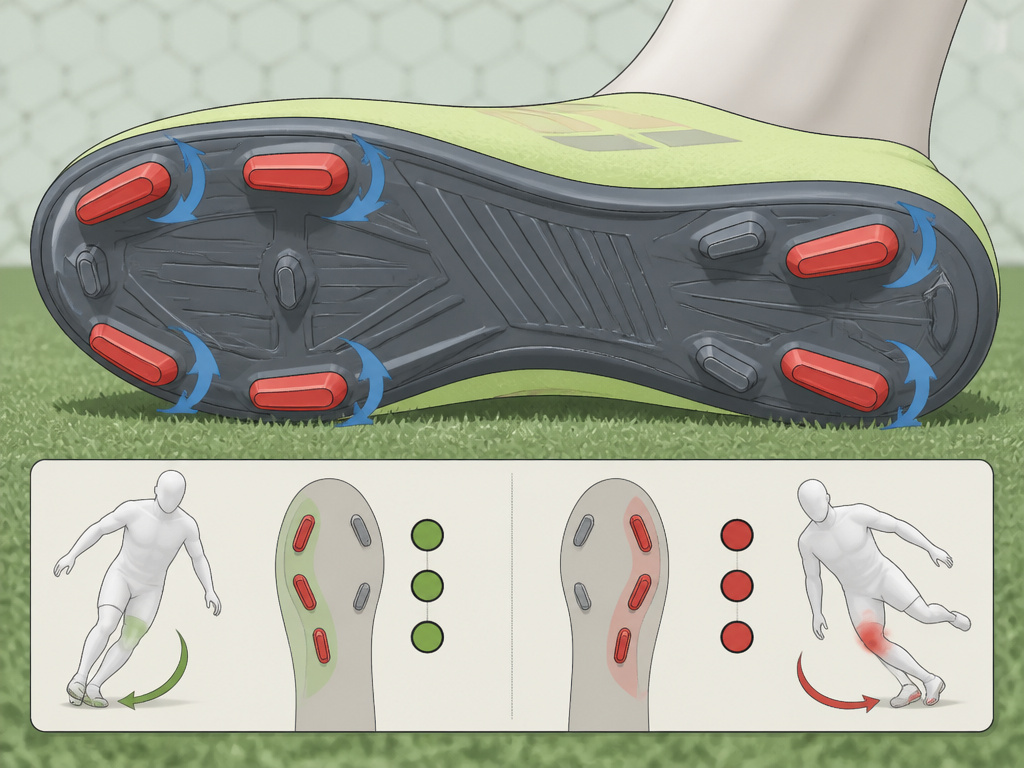
This isn’t scare talk. It’s documented cause and effect. Choosing a boot is a biomechanical intervention.
The number and placement of studs matter as much as their shape. Research has linked specific patterns to injury risk:
- Low Stud Count on AG: As cited, the six-stud pattern is contraindicated on artificial grass. The few, often longer studs act like pylons, concentrating force and creating high rotational stiffness.
- Medial/Lateral Imbalance: A 2023 injury analysis found that an increase in medial rearfoot studs and a decrease in lateral rearfoot studs was associated with a higher appearance of foot injuries during running. The foot rolls inward (pronates) differently.
- Forefoot Studs and Ankles: The same study noted that the number of studs in the toes was a better predictor of ankle injuries than rearfoot configuration. This makes sense, the forefoot is your pivot point.
The surface itself is a variable. Artificial grass produces a greater moment of force than natural grass. Your joints absorb that extra torsional load unless your boot (specifically an AG pattern) is designed to mitigate it. This is why the casual switch from FG vs AG boots is a real problem. The FG pattern, with fewer, longer studs, can grip the synthetic turf too well, refusing to release during a twist and transferring that force to your knee.
How to Choose: A Practical Framework
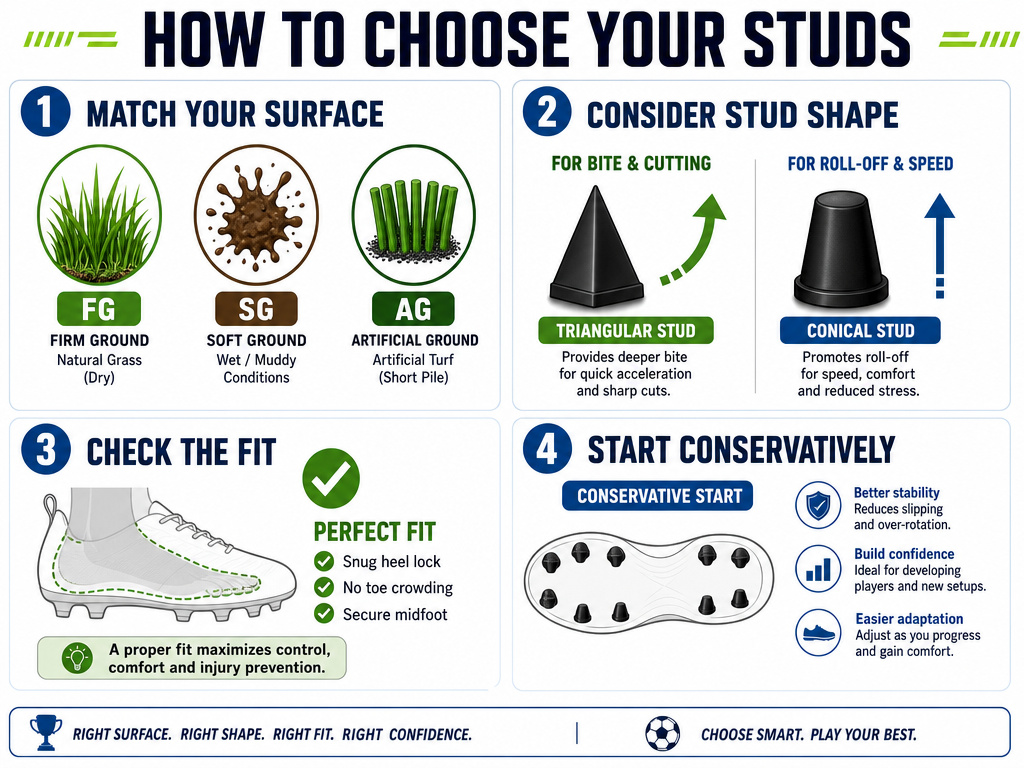
Forget the marketing. Follow this sequence.
- Identify Your Primary Surface. Be honest. Is it a pristine Saturday league pitch (FG), a muddy Wednesday night training ground (SG), or a modern 3G facility (AG)? This is your essential first filter. Choosing the right boot for your playing surface is critical.
- Consider Your Role & Movement. A winger making explosive cuts might lean towards a pattern with triangular or bladed forefoot studs for that “bite,” accepting the different load profile. A central midfielder covering ground might prefer the smoother roll-off of conical studs. It’s a trade-off.
- Prioritize Fit Over Everything. The most advanced soleplate designs are worthless if the boot doesn’t fit. Your foot shouldn’t slide, and there should be no pinch points. A correct football boot fit is the foundation all traction is built upon. Once you know your fit in a brand (Adidas, Nike, Mizuno), then look at the stud patterns they offer for your surface.
- Start Conservative. If you’re unsure, choose the safer option: more studs for AG, conical shapes for smoother release, and always a dedicated surface boot over a multi-ground compromise. You can experiment from a baseline of lower risk.
Before you start: Never wear a new boot pattern for the first time in a match. Wear them for a light training session or even just around the house to feel the pressure points. A poorly fitted or poorly chosen boot can cause blisters or alter your movement within minutes.
The Unseen Factor: Women’s Boots & The Fit Gap
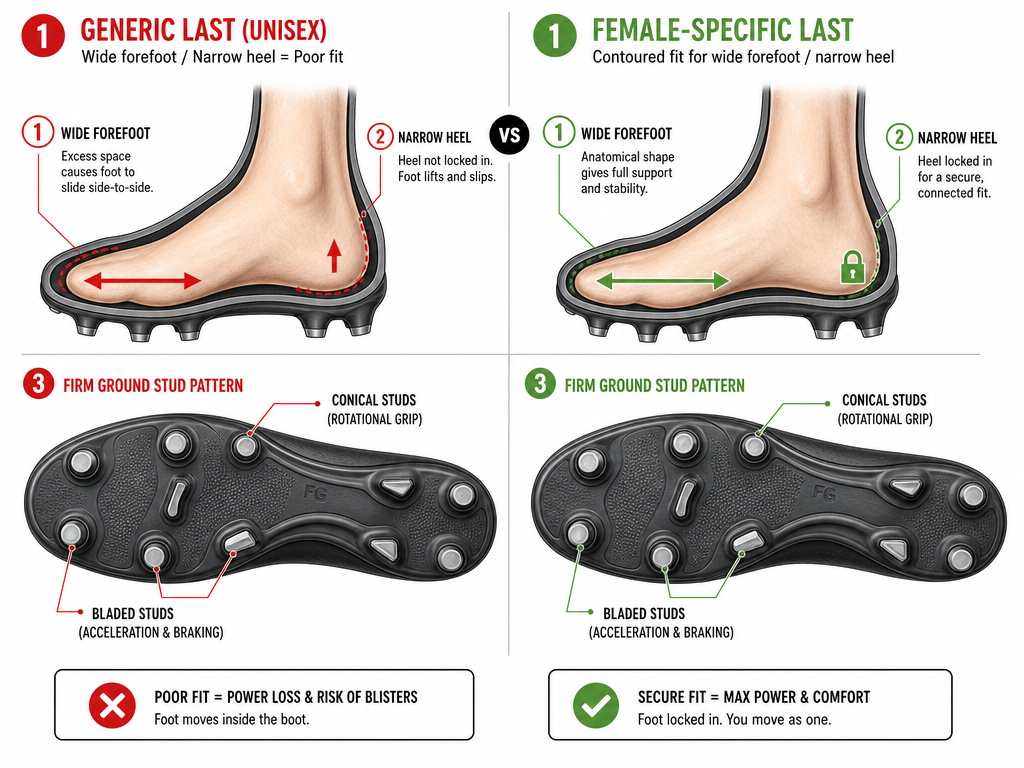
Here’s a quiet problem that changes the data. Much of the biomechanical research on studs, including the studies cited here, has been conducted on male athletes, often wearing boots built on a male foot last.
Female foot morphology is different, typically a narrower heel, wider forefoot, and higher arch. A 2024 review paper highlighted the historical lack of dedicated research and development focused on female athletes’ biomechanical needs. The old “shrink it and pink it” approach means many female players are in boots that don’t fit their heel properly, altering how their foot sits within the soleplate and, consequently, how the studs engage the ground.
This isn’t a small detail. An ill-fitting boot changes everything the stud pattern was engineered to do. If you’re a female player, seek out brands offering genuine female-specific lasts (not just colorways) and prioritize that heel lock. The stud technology is secondary to a secure platform.
Frequently Asked Questions
What are the different types of studs on football boots?
They’re categorized three ways: by shape (conical, bladed, triangular/hybrid), by construction (moulded into the soleplate or removable screw-in), and by intended surface (Firm Ground/FG, Soft Ground/SG, Artificial Grass/AG, Turf/TF). The surface category is the most important for safety and performance.
Which type of studs is best for football?
There’s no single “best.” It’s a match of tool to task. Conical studs are the most common and offer smooth rotational release. Bladed studs can provide fierce linear traction. Triangular studs have shown good explosive force for cutting on artificial turf in studies. The “best” is the shape within the correct surface category (FG, SG, AG) that suits your playing style and feels stable.
What are 7 stud cleats?
This typically refers to a traditional screw-in Soft Ground (SG) configuration. A “7-stud cleat” describes the soleplate layout, often with a 4-stud forefoot and 3-stud heel setup. It’s a classic pattern for muddy, penetrable surfaces. Remember, this low stud count is exactly what makes it risky on firm or artificial surfaces.
What are the three different types of football boots?
This usually refers to the primary surface categories: Firm Ground (FG), Soft Ground (SG), and Artificial Grass (AG). Some classifications add Turf (TF) as a fourth and Multi-Ground (MG) as a hybrid fifth type. The core three differ fundamentally in stud length, number, and material to address the unique demands of each pitch.
Can I use Firm Ground boots on artificial grass?
You can, but you shouldn’t. Laboratory research shows artificial grass exerts a greater moment of force than natural grass. FG boots, with fewer, longer studs, are more likely to grip the synthetic turf and resist rotation, transferring that twisting force up to your knee. Dedicated AG boots, with their many short studs, are designed to release more cleanly, reducing that injury risk. The differences between firm ground and artificial grass boots are about injury prevention, not just grip.
Before You Go
The clearest sign you’re in the wrong boots is a specific pain: a hot spot on the ball of your foot after playing on a hard surface (SG studs at fault), or a feeling of your foot “sticking” and your knee twisting on a synthetic pitch (FG studs on AG). Listen to those signals.
If you take one thing, let it be this: your boots are the only part of you that touches the pitch. That interface is a biomechanical system. Choose for that system, surface first, fit second, pattern third. Using soft ground boots on firm surfaces carries specific risks, and using firm ground boots on artificial grass also increases injury risk. Start with the ground under your feet, and work upwards. Everything else is just decoration.
