
How to Stay Focused During a Football Match: Step-by-Step
This post contains affiliate links. As an Amazon Associate, we earn from qualifying purchases.
To stay focused during a football match, you must control your attentional spotlight, switching between four types of focus, broad external, narrow external, broad internal, and narrow internal, based on the game state. The core skill isn’t blocking out distractions, but knowing where to point your attention and having pre-planned triggers to bring it back when it wanders, which frequently happens due to match tempo disruptions.
The difference between seeing the game and getting lost in it comes down to that deliberate switch. A key part of how to stay focused during a football match is using the right mental beam at the right time. A midfielder scanning for a pass uses a different mental beam than a striker lining up a shot. Get the beam wrong at the wrong moment, and you are playing in the dark.
What follows is a framework, not a pep talk. We will break down the four types of focus you actually need, map the specific moments your concentration breaks (backed by coach interviews), and give you the refocusing triggers that work when the crowd is loud and your head is louder.
Key Takeaways
- Your focus is a spotlight you control; you cannot lose it, but you can point it at the wrong target, like your own anxiety instead of the opponent’s movement.
- Over 50% of concentration disruptions come from match tempo, stoppages, free-kicks, throw-ins, so your refocusing plan must start at these dead-ball moments.
- Effective self-talk follows a specific structure: short, first-person, present-tense, positive, goal-significant, and planned in advance, not invented in the moment. Negative thoughts must be substituted with these positive affirmations.
- A 15-minute mindfulness practice can significantly increase visual fixation under pressure, but a PLOS One study found it did not, in the same session, directly improve penalty kick scores; it sharpens the tool, but you still have to use it.
- Build focus stamina by training in varied, distracting conditions; if you only practice in silence, you will only perform in silence.
What 87% of Disruptions Are (And It’s Not the Crowd)
You think concentration breaks when the opposition striker skins you. Or when the away fans start a deafening chant. The research says you are mostly wrong.
A 2024 study interviewing French national youth team coaches identified six categories of concentration disruption. The biggest one, accounting for more than half of all cited disruptions, was match tempo. Think about the flow-breakers: free-kicks taking too long to set up, a throw-in on the far side, the ball going out for a goal kick, an injury stoppage. These are the silent killers of focus.
Where this goes sideways: Assuming you will stay “switched on” for 90 minutes. The game’s natural stop-start rhythm is designed to break your flow. If you do not have a deliberate ritual to re-engage at every stoppage, you will spend the first 10 seconds after the restart catching up.
The other five categories are individual factors (like being a frustrated substitute), your weekly training routine, the match context, fatigue, and situational factors like the score. But the tempo piece is the lever you can actually pull. Your first refocusing trigger is any dead ball. That is the signal. Not when you feel tired, but when the whistle blows.
The mental work here is acknowledging that lapses are normal and predictable. They are not a moral failure. They are a design feature of the sport. Your job is to have a faster reboot time than the player you are marking.
The 4 Types of Football Focus (And When to Use Them)
A coach yells “Focus!” from the touchline. It is about as useful as a chef shouting “Cook!” This is the commodity advice every article repeats. The non-commodity part is that “focus” is not one thing. It is four distinct settings, and using the wrong one is why you make bad decisions.
The model comes from work cited by bodies like the NFL Players Association and New Zealand Equestrian. Your attention has two dimensions: width (broad or narrow) and direction (internal or external). Combine them, and you get your four mental tools.
| Focus Type | What It Is | Football Example | Use It When… |
|---|---|---|---|
| Broad External | Scanning the whole environment for information. | A midfielder checking opponent shape, space, and teammate positions before receiving a pass. | You are in possession and have time to make a decision. |
| Narrow External | Zooming in on one or two specific external cues. | A goalkeeper tracking the ball’s spin and trajectory from a corner. | Executing a technical skill (shooting, tackling, catching). |
| Broad Internal | Analyzing information internally to form a plan. | A defender recognizing a familiar attacking pattern and organizing the defensive line. | During a stoppage, or in the seconds after you lose possession. |
| Narrow Internal | Controlling your own thoughts and feelings. | Using a breathing technique to settle nerves before a penalty. | You feel anxiety rising or need to reset after a mistake. |
The skill is not just knowing these exist, but switching between them on demand, a core answer for how to stay focused during a football match. A common mistake is getting stuck. A striker stuck in broad internal focus is overthinking and will be late to every rebound. A defender stuck in narrow external focus, only watching the ball, will get dragged out of position by a simple decoy run.
This is also where experts and amateurs diverge sharply under pressure. Research from King’s College London notes that in high-pressure moments, an amateur’s focus typically narrows to the technical execution (“keep my knee over the ball”). An expert, with technique automated, shifts focus to the tactical components (“the keeper is leaning left”). One is playing the game. The other is playing their own technique.
Your Pre-Match Routine: Building the On-Ramp
Concentration does not appear at kick-off. You build the on-ramp during your warm-up. This is where you move from the clutter of the day, school, work, traffic, into the single channel of the match.
A pre-performance routine provides focus while also creating a sense of familiarity that can reduce anxiety, as noted by the NFLPA. It is not about superstition. It is about sequence. The sequence tells your brain, “We are here to do this now.”
A useful frame is the “switch on” zone. Ronan O’Gara, the former Ireland rugby fly-half, spoke about the deliberate mental preparation he needed. Some players use the walk from the dressing room to the tunnel. For others, it is the moment they finish their last dynamic stretch. Find your gate.
I have watched youth teams where the warm-up is just a loose kickabout. The first ten minutes of the match are then spent with players looking like they have just been dropped into a foreign country. They are not unfocused. They are unprepared.
Your routine should include a physical, technical, and mental component. The physical gets your body ready. The technical, a few sharp passes, a strike on goal, primes the muscle memory. The mental component is where you set your performance goals.
Forget “win the match.” Set goals like “first pass to feet” or “communicate every defensive transition.” These are controllable, action-oriented, and give your spotlight a clear, immediate target. They are an antidote to anxiety, which, as the New Zealand Equestrian guide points out, can narrow your beam inward, though research on expert athletes under pressure also shows a shift towards tactical focus. Action goals force it outward.
In-Game Tools: Self-Talk, Cues, and the 15-Minute Mindfulness Reality
The match is live. Your heart is up. This is where your planned tools either work or they are just theory.
The Architecture of Self-Talk
“Come on, you can do this.” That is almost useless. Effective self-talk is a specific protocol. The King’s College London study outlines a structure for it. Your internal dialogue should be: 1. Short and specific. 2. In first-person present tense (“I see the space”). 3. Positive. 4. Goal-significant. 5. Planned and repeated in advance. It should also be used to substitute negative thoughts with positive affirmations.
This turns self-talk from a hopeful whisper into a functional command. Instead of “don’t miss,” you have a pre-loaded phrase like “smooth follow-through.” It is instructional and redirects your attention to a technical cue you can control.
Cue Words: Your Mental Shortcuts
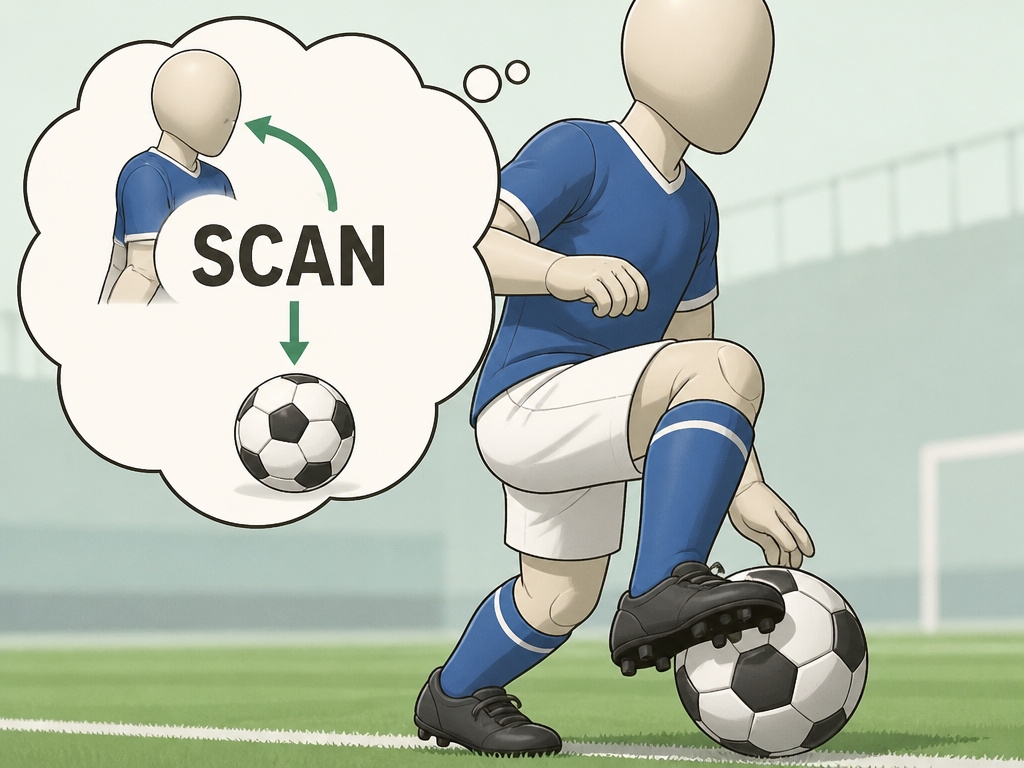
Cue words are the distilled version of self-talk. They are short, vivid verbal reminders. Serena Williams used to read them on notes during changeovers. On a football pitch, they are triggers you pair with an action.
- “Scan” when you receive the ball with your back to goal.
- “Shift” when the ball is switched to the opposite wing.
- “Recover” immediately after you lose possession.
The critical rule from the NFLPA: you must practice this pairing for it to be effective in competition. Say “scan” every time you receive in training. Drill the connection until the word fires the action without thought.
The Mindfulness Mismatch
Mindfulness is everywhere in sports psychology. But what does it actually do in the 90 minutes? A study in PLOS One provides a clear, and perhaps surprising, answer. Researchers gave university football players a 15-minute brief mindfulness training before taking penalty kicks under pressure. An eye-tracker measured their visual attention.
The results? The mindfulness group showed significant gains in fixation duration and fixation count on the target compared to the control group. Their visual focus was sharper and more stable. However, and this is vital, penalty kick scores did not significantly improve in that same session.
The PLOS One mindfulness study found mindfulness sharpened the tool of attention under pressure, but converting that sharpened tool into a better result required more than one 15-minute session.
Mindfulness, in this light, is not a magic pill for immediate performance. It is training for your attentional muscle. It helps you notice when your spotlight has drifted to the crowd (external distraction) or to your own dread (internal distraction), so you can bring it back. It builds the stability you see in experts who analyze a few relevant elements for a longer duration. But you still have to put the ball in the net.
How to Refocus When You’ve Lost the Thread
You will lose focus. The French national coaches study proves it is inevitable. The skill that separates players is not prevention, but speed of correction.
Have a refocusing ritual ready for the most common lapses:
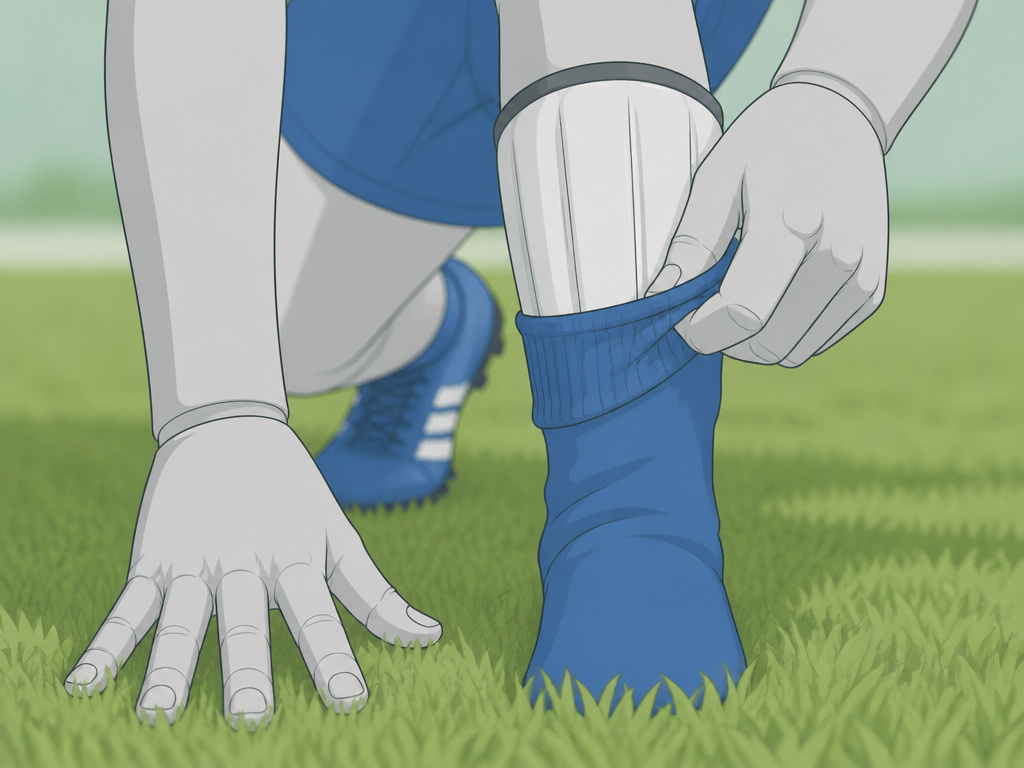
- After a mistake: Your ritual is physical. Touch the ground, adjust your socks, take a deep breath. This creates a physical “reset” that interrupts the loop of negative internal self-talk. The action is the cue to move to the next moment.
- During a stoppage: Use the dead time. Walk to your position. Rehearse your cue word for the next phase (“compact” on defence, “spread” on attack). This directly attacks the #1 disruption: match tempo.
- When fatigued: Switch your focus type. If your legs are gone, you cannot rely on broad external scanning, it takes too much energy. Narrow your focus to a single, simple task: “mark my player” or “first touch clean.” Simplify your game to conserve mental bandwidth.
Simulation training is how you make these rituals robust. Practice with intentional distractions. Have a teammate talk trash during a finishing drill. Concede a soft goal in a small-sided game and immediately practice your reset ritual. Train under fatigue at the end of a hard session. If your focus only works in perfect conditions, it is not a skill. It is a coincidence.
Position-Specific Spotlights
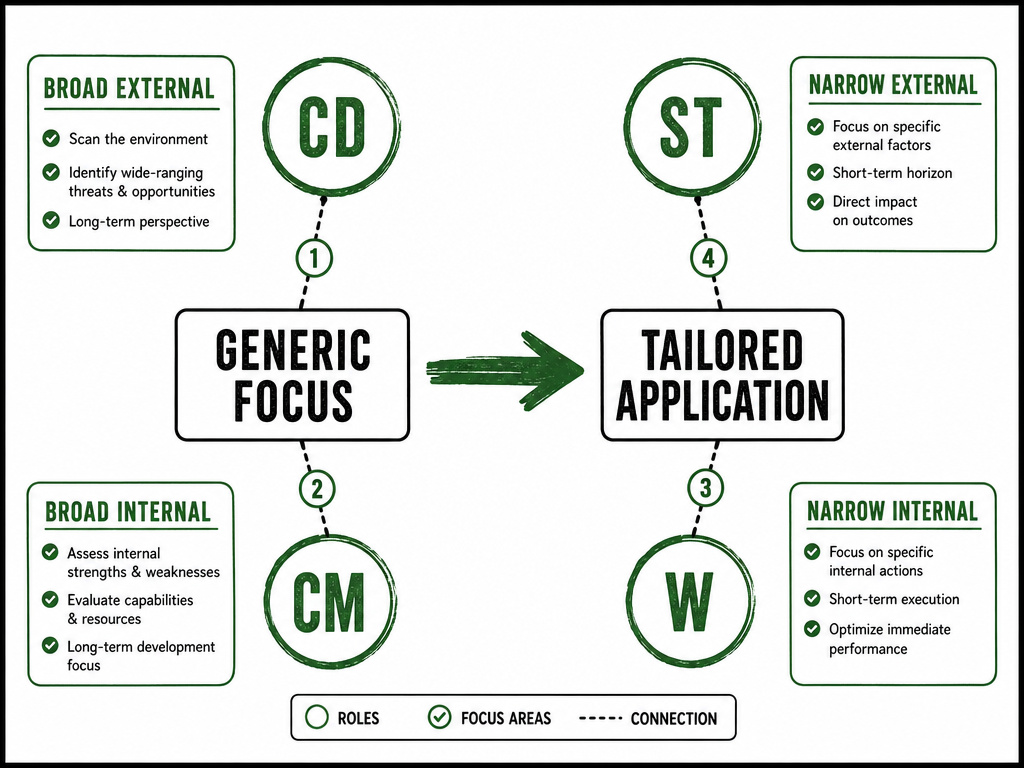
A goalkeeper’s focus is not a midfielder’s focus. While the four types apply to everyone, the weighting and triggers differ by role. This is the gap generic “focus” articles miss.
- Central Defender: Your dominant mode is broad external, organizing the line, tracking runner interchanges. Your refocus trigger is any moment the ball is in the opponent’s half. Use that time to communicate and scan.
- Central Midfielder: You are the switchboard. You must cycle between broad external (scanning before receiving) and narrow external (the technique of the pass itself) faster than anyone. Your cue word is often “turn” or “play,” triggered by the sound of a teammate’s call.
- Winger: Your focus is often narrow external on the full-back in front of you, with bursts of broad internal to check for the overlapping runner. Your disruption is isolation; your refocus ritual is to simply check the position of your nearest support player.
- Striker: You live in narrow external focus (the ball, the goal) but must violently switch to broad internal when you lose possession to trigger the press. Your biggest challenge is staying engaged when the play is far away, use that time to analyze the centre-backs’ relationship.
The principle is the same: deliberate spotlight control, which is the essence of how to stay focused during a football match. The application is tailored. A defender shouting “focus!” at a striker who just missed a sitter is yelling at them to use the wrong tool.
Frequently Asked Questions
What is the most common focus mistake footballers make?
The most common mistake is using narrow internal focus when you need narrow external. When anxious or after a mistake, the spotlight turns inward on your feelings (“I’m nervous,” “I’m awful”). The fix is to use a pre-planned cue word to force your attention onto one external, technical detail, the ball’s valve, a spot on the goal, to break the internal spiral.
How can I improve my concentration stamina for a full match?
You build concentration stamina the same way you build physical stamina: through progressive overload in training. Use simulation training. Design drills that require sustained decision-making under fatigue or distraction. Play a possession game with a man down, or run a demanding fitness drill immediately before a finishing exercise. This conditions your mind to operate when tired, which is when most lapses occur late in games.
Does listening to music with headphones before a match help focus?
It can, but only as part of a deliberate routine. The music itself is not the focus aid; the consistency is. If putting on headphones signals to your brain that it is time to shift into a competitive mindset, then it is a valuable trigger. The key is that it is a repeatable step in your broader pre-match preparation, not just a way to kill time.
How do I deal with a teammate who is constantly breaking my focus with negative talk?
First, control your own spotlight. Their comment is an external distraction. Acknowledge it (do not fight it), then actively redirect your attention using your cue word or a physical ritual. In the long term, have a calm, private conversation. Frame it around performance: “When we get negative after a mistake, it takes us three minutes to get organized again. We can agree on a word to reset us instead.
What is the single best exercise to improve in-game focus?
The scanning drill. During any possession drill in training, mandate a “scan” before receiving every pass. Force your head to check your shoulder. This trains the muscle memory of shifting from broad external (scanning) to narrow external (controlling the pass). It makes environmental awareness a required part of your technique, which is the foundation of improving your football IQ.
The Bottom Line
Staying focused is not about willpower. It is about preparation and protocol. You prepare by knowing the four types of focus and practicing the switches. You build protocol through pre-match routines, engineered self-talk, and refocusing rituals for the inevitable breaks.
The modern game is a series of interruptions. The player who wins is the one who treats each stoppage not as a loss of flow, but as a chance to reset their spotlight with intention. That is the move from hoping to concentrate, to knowing how.
Start this week not by trying to focus more, but by choosing one thing. Pick one cue word for your position. Practice pairing it with an action for twenty repetitions in training. That specific, small wiring job is how you build a mind that works for you when the pressure comes, not against you.
