
How to Be a Leader on the Football Pitch: Step by Step
This post contains affiliate links. As an Amazon Associate, we earn from qualifying purchases.
Leadership on the football pitch is not about being loudest or most talented. It’s about deploying specific, observable micro-behaviors that build psychological safety and collective efficacy within the team. This produces more stable, consistent team performance across a season, reducing week-to-week fluctuations, rather than directly causing more wins. The captain’s armband is optional; the right actions are not.
That distinction between stability and scoring is the whole game. Most guides tell you how to be a leader on the football pitch leads to victory. The data says it leads to consistency, which is a different and more valuable currency over the grind of a season. It means your team performs to its level more often, avoids wild swings, and handles pressure with a clearer structure.
What follows is a breakdown of what leadership actually changes, the five specific behavior categories that work, how to lead without the armband, and the one situational factor that can undo it all.
Key Takeaways
- Leadership’s proven impact is on performance stability, not match points. A 2026 study found a PERMA-based leadership intervention reduced week-to-week performance instability significantly but did not increase points per game.
- Build psychological safety and collective efficacy. Those two team resources showed reliable increases following focused leadership behaviors, creating an environment where players take smart risks and trust the unit.
- Master five leadership micro-behavior categories: positive emotional framing, task-focused engagement, relational actions, meaning-oriented communication, and accomplishment-oriented feedback.
- Look for leaders beyond the captain. Research shows informal peer leaders are often perceived as “good or better” than the official captain. Leadership is a role, not a title.
- Understand that competitive pressure is a moderator. The stabilizing effect of good leadership weakens when situational pressure is at its highest. Your plan must account for that.
What Does Leadership Actually Change? (The Science, Not the Hype)
Forget the cliché about leaders dragging teams to victory through sheer will. The evidence points somewhere else.
A 2026 peer-reviewed field study in the Frontiers in Psychology journal tracked 10 professional and semi-pro football teams for 24 weeks. Researchers introduced a structured leadership program and measured everything from player perceptions to match outcomes. The results reframe the conversation.
The intervention was associated with a reduction in week-to-week performance instability. Teams became more consistent. Their results didn’t swing as wildly from one match to the next. That’s huge over a long season. However, the same study found no consistent change in match points per week. Leadership didn’t directly cause more wins in this study. It caused more predictable, stable performances.
Leadership micro-behaviors may be associated with context-sensitive patterns of team functioning, particularly in relation to performance stability rather than immediate competitive success. , Frontiers in Psychology (2026)
So what did improve? The study found three team resources that increased reliably after the leadership intervention: perceived leadership quality, psychological safety, and collective efficacy. The first is how players see you. The second two are the engine.
Psychological safety is the shared belief that the team is safe for interpersonal risk-taking. It’s the difference between a player hiding a mistake and immediately communicating it to organise the defence. Collective efficacy is the team’s shared confidence in its ability to execute tasks. It’s the unspoken certainty that your pressing trap will work. Leadership builds those. Stability follows.
The Five Micro-Behaviors That Build a Leader (Not a Speech)
If leadership is about specific actions, what are they? The same 2026 study structured its intervention around five categories of observable, coachable behaviors derived from the PERMA well-being framework. This is your toolkit.
- Positive Emotional Framing. Acknowledge effort and progress immediately. It’s not false cheer. It’s specifically naming a recovery run or a smart tactical foul. This tells the team what to repeat.
- Task-Focused Engagement Cues. In stressful moments, direct attention to the next controllable action. “Win the second ball.” “Hold the shape.” It cuts through noise and anchors the team in the process.
- Relational Behaviors. Create structured chances for input and communicate that mistakes are part of the game. Ask a player for their read on an opponent’s weak side at halftime. This builds the psychological safety the study measured.
- Meaning-Oriented Communication. Connect individual tasks to the team’s bigger objective. “Your pressing from the front is what triggers our whole defensive shift.” It turns a job into a purpose.
- Accomplishment-Oriented Feedback. Reinforce execution and mastery, not just the scoreboard. “The way we sustained our press for 20 minutes in the first half was perfect, regardless of the goal.” This builds collective efficacy for next time.
These aren’t personality traits. They are habits. You can practice them in training, in five-a-side, in the dressing room. The study’s coaches learned them in a structured session. The key is moving from a vague “be a leader” to the concrete “use a task-focused engagement cue now.”
Leading Without the Armband: The Power of Informal Peer Leadership
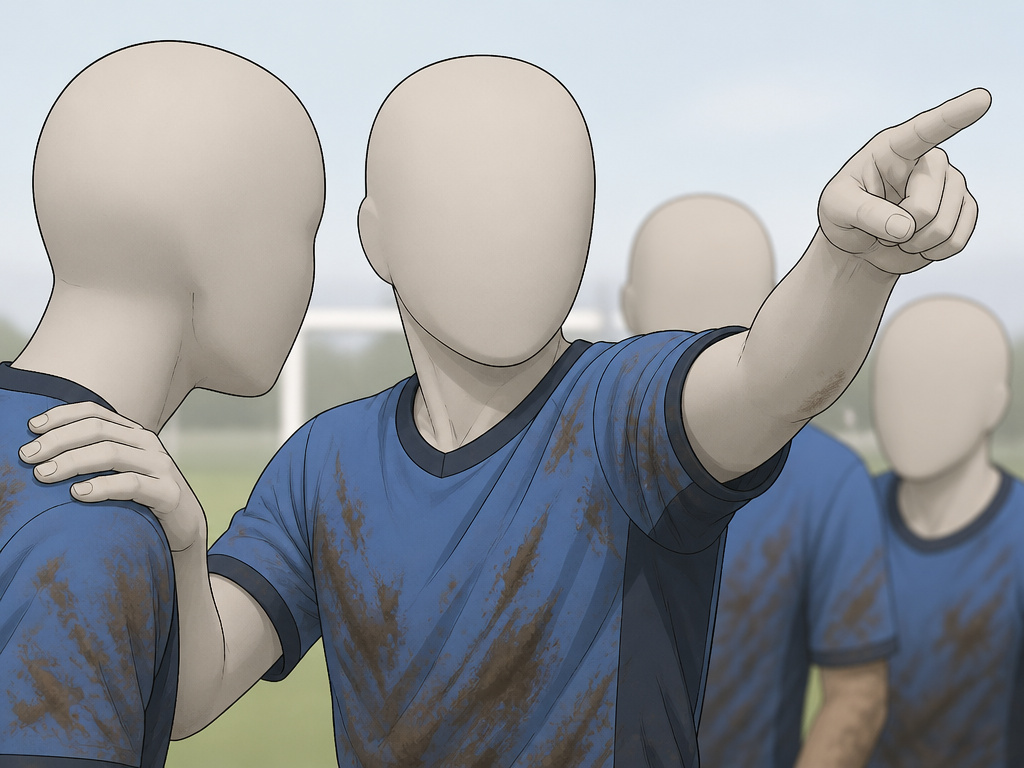
You do not need to be captain, the star player, or the veteran to lead. In fact, the formal title can sometimes get in the way.
A separate 2026 qualitative study in the Scandinavian Sport Studies Forum interviewed coaches and players from a national team setup. Its conclusion was blunt: informal peer leaders are often perceived as “good or better leaders than the team captain.” The researchers advised to actively “look beyond the team captain” for leadership.
This matches what you see on a muddy Sunday league pitch. The organiser is often the centre-mid who constantly talks, or the full-back who manages the defensive line. They have the trust and the situational awareness. Their authority comes from action, not a title.
So how do you become that player?
- Own Your Zone: Be the complete expert on your specific role. If you’re a winger, know the full-back’s tendencies inside out. Your teammates will start listening.
- Bridge Communication Gaps: See a midfielder and forward not linking? Simplify the message for both. “He wants it to feet, play the earlier pass.” You become the tactical translator.
- Model the Reaction: Your response to a mistake or a bad call sets the emotional temperature for the whole side. A calm, immediate shift to recovery mode is a silent leadership act.
This is where developing a high football IQ pays dividends. The better you understand the game, the more valuable your unspoken cues and tactical nudges become.
| Formal Captain | Informal Peer Leader | When Each is Most Effective |
|---|---|---|
| Official communicator with referees | Tactical organiser in the flow of play | Set-pieces, protests to officials / Open-play transitions, defensive organisation |
| Represents team in media/club affairs | Emotional barometer for the squad | Pre/post-match rituals / Reacting to momentum swings during the match |
| Holds symbolic responsibility | Provides real-time, role-specific feedback | Team meetings, formal talks / In-game adjustments, positional reminders |
The Foundation: Role Clarity and the 5Cs Framework
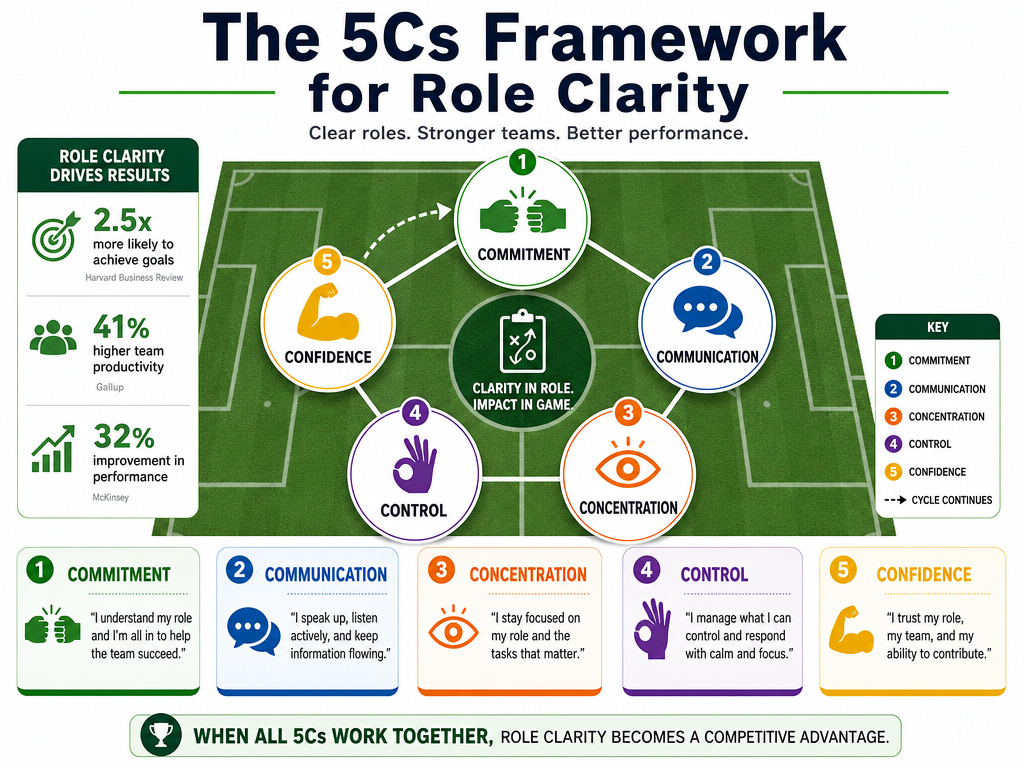
Confidence is often just the product of knowing exactly what your job is. A leader, formal or informal, helps create that clarity.
Research supports this. An accepted manuscript from Nottingham Trent University on enhancing role clarity in youth football proposes the 5Cs framework for defining roles: Commitment, Communication, Concentration, Control, and Confidence. It’s a checklist for making responsibilities crystal clear.
A leader on the pitch operationalises this framework. For a teammate:
- Commitment: “Your job is to track their number 8’s late runs. Every time.”
- Communication: “Shout ‘man on’ early for me, I can’t always see over my shoulder.”
- Concentration: “The first 5 minutes after we score are key. Switch on.”
- Control: “You can’t control the referee. You can control your reaction to him.”
- Confidence: “You’ve beaten this full-back before. Go at him again.”
This moves the question of how to be a leader on the football pitch from motivational rhetoric to instructional clarity. It directly builds the collective efficacy, the belief the team can execute, that the Frontiers study linked to stability. When everyone knows their job and trusts others to know theirs, the team makes fewer panic-driven errors. This is the bedrock of team defending and organised play.
Common mistake: Defining roles only by position (e.g., “you’re a midfielder”). A leader defines roles by situation (“when we lose possession, your first job is to block the passing lane to their 10”).
Communication: The Practical Scripts They Never Give You
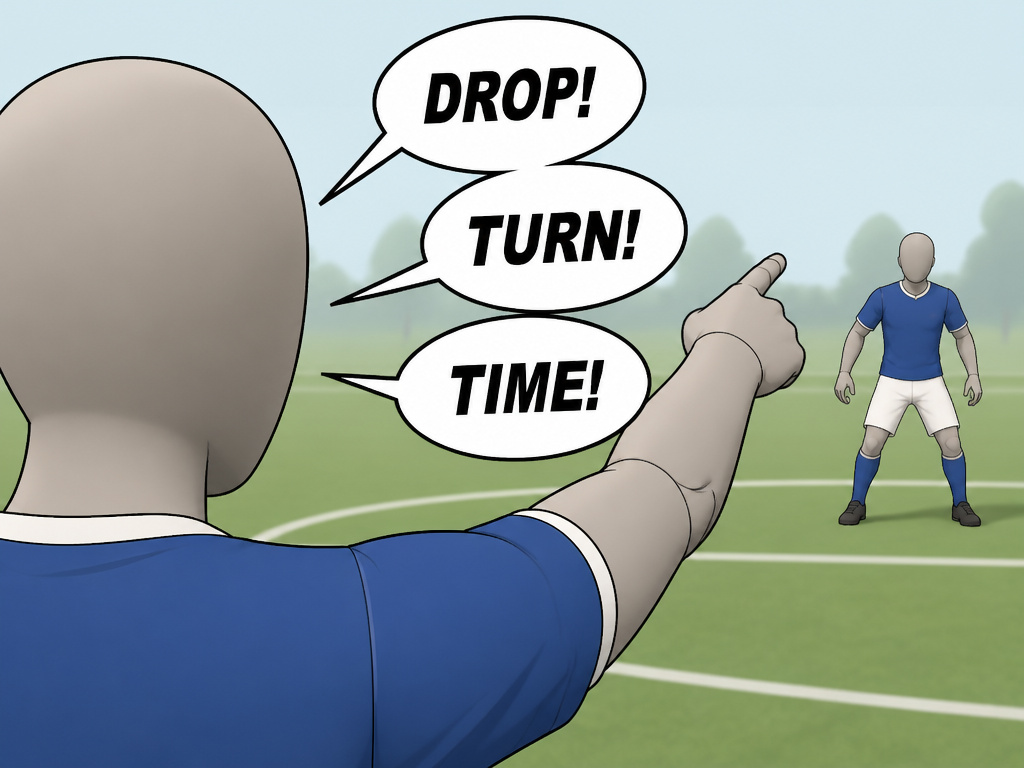
Telling someone to “communicate more” is useless. Here is what to actually say, and when.
Defensive Organising:
- “Drop!” / “Step!” – The most basic commands for defensive line coordination.
- “Show inside!” / “Show outside!” – Instructing a teammate which way to force an attacker.
- “Time!” – Letting a teammate know they have space to control the ball.
- “Man on!” – The essential warning, delivered early.
Attacking & Transition:
- “Turn!” – Telling a player with their back to goal they have space to pivot.
- “Line!” – Calling for a pass along the defensive line, usually for a switch of play.
- “One-two!” – Proposing a specific combination.
- “Carry!” – Encouraging a player to drive forward with the ball.
The best leaders mix instruction with acknowledgement. A shouted “Good shift!” after the team collectively presses and wins the ball reinforces the behavior. This is the practical application of how to be a leader on the football pitch, turning theory into on-pitch reality. For more on the mechanics, our guide on on-field communication explains it in detail.
The Leadership Killer: When Competitive Pressure Bites
Here is the crucial caveat from the research. Leadership is not a magic shield.
The 2026 Frontiers study included a vital moderation analysis. They found that the positive association between leadership micro-behaviors and performance stability was attenuated under conditions of elevated competitive pressure. In high-stakes, high-stress moments, a cup final, a relegation six-pointer, the calming, stabilizing effect of good leadership becomes harder to sustain.
Where this goes sideways: Assuming your leadership will function the same in a calm league game as in a high-pressure final. The research shows pressure weakens the effect, so your communication must become simpler, more repetitive, and more process-focused.
This doesn’t mean you stop leading. It means you simplify. Your task-focused engagement cues become shorter and more frequent. Your positive framing focuses solely on the next action. You might rely more on pre-rehearsed routines, like a specific set-piece or pressing trigger, to bypass decision-making under stress. Understanding this sports psychology principle is key to adapting when it matters most.
Frequently Asked Questions
How can I become a leader if I’m not the best player?
Leadership is about influence, not skill. Start by mastering the five micro-behaviors, especially relational actions and task-focused cues. Be the most reliable player in your role, and use your on-field awareness to help others. The research shows informal peer leaders are often more effective than the official captain.
What are the top skills for a football leader?
Based on the research, the top skills are: 1) The ability to give clear, task-focused instructions (engagement cues). 2) Building psychological safety through error-tolerant communication. 3) Connecting individual actions to team objectives (meaning-oriented communication). 4) Maintaining mental composure to provide stability under pressure.
How do you lead a disorganized team?
Start with extreme role clarity using the 5Cs framework. Simplify the game into one or two essential rules for everyone (e.g., “we all recover behind the ball”). Use constant, simple verbal and visual communication to organise. Praise any movement towards structure, no matter how small. It’s a grind, not a speech.
Can you teach someone to be a leader?
You can’t teach charisma, but you can absolutely drill the observable micro-behaviors that constitute leadership. Coaches can run sessions focused on communication, designate leadership moments for different players, and debrief not just tactics but leadership actions. The Frontiers study proved coaches learned and applied these behaviors effectively.
Before You Go
Leadership on the pitch is a practical trade. It’s less about what you feel and more about what you do, the specific words, the focused cues, the reaction to a mistake that says “next play.”
The data gives us a clearer picture: aim to build the resources (safety, efficacy) that create stable performance, not just to fire up the team for one win. Remember that your influence as a peer can be more powerful than any armband, and that even the best leadership has limits when the pressure is cranked to its maximum.
So pick one micro-behavior this week. Maybe it’s positive framing after a tough tackle. Maybe it’s a single, clear task cue when your team is under the cosh. Practice it. The consistency you help build will outlast any single moment of inspiration.
