
Ankle Sprain From Football Recovery: The 4-6 Week Rule
This post contains affiliate links. As an Amazon Associate, we earn from qualifying purchases.
Ankle sprain from football recovery follows a 4–6 week functional treatment plan, not prolonged rest. For most lateral sprains, a lace-up or semi-rigid brace is preferred over an elastic bandage or tape, and supervised exercise therapy should start early to cut reinjury risk by nearly 40%. The goal is safe return to play, not the fastest return.
That 4–6 week window comes straight from the British Journal of Sports Medicine, it’s the core evidence update that changed how physios treat this. The old “rest until it stops hurting” model leaves the ankle weak and sets you up for another twist on the first cut back. Functional treatment means protecting it while you move.
What follows is the football-specific version of that plan. We’ll walk through the immediate steps, the gear that actually works, the exercises that rebuild trust in your ankle, and the exact on-field progression to get you back. We’ll also tackle the tricky part: why a 15-day layoff for a pro might be a warning sign, not a success story.
Key Takeaways
- Use a lace-up or semi-rigid brace for 4–6 weeks; elastic bandages and Kinesiotape don’t provide enough mechanical support for an unstable ankle.
- Start supervised exercise therapy early; it can reduce the risk of recurrent sprains (RR 0.62) according to the BJSM.
- For severe (Grade III) sprains, limit immobilization (like a walking boot) to a maximum of 10 days before switching to functional treatment.
- In professional football, the average time-loss is 15 days with a 17% recurrence rate, a sign that returning “when pain allows” is often too soon.
- Wear a brace during sport for up to 12 months after recovery for the best protection against reinjury, per the American Academy of Family Physicians.
The 4–6 Week Functional Support Rule
The biggest shift in recovery involves a timeline rather than a new exercise. The British Journal of Sports Medicine guideline states functional support for 4–6 weeks is preferred over immobilisation. That means your ankle should be working in a protected range, not sitting still in a cast or boot for weeks on end.
The type of support matters just as much. The same BJSM meta-analysis found a lace-up brace or a semi-rigid brace should be preferred to the use of an elastic bandage. An elastic bandage might help with initial swelling, but it doesn’t give your healing ligaments the stable platform they need when you start to weight-bear and move. Kinesiotape is in the same boat, the guideline notes it’s unlikely to provide sufficient mechanical support in unstable ankles.
Common mistake: Relying on an old elastic bandage or tape job for support. They compress, but they don’t stabilise. A proper brace controls the sideways roll that caused the sprain in the first place.
This principle focuses on matching the tool to the job, not on buying the most expensive gear. A lace-up brace provides adjustable compression and lateral support. It’s the difference between propping up a wobbly table with your hand versus bolting on a bracket.
Immediate Care: What Actually Works on Day One
You’re on the pitch, you go over on your ankle, and it starts to swell. The old RICE (Rest, Ice, Compression, Elevation) mantra is everywhere. The evidence for it, however, is thinner than you’d think. A major review in Acute ankle sprain in athletes: Clinical aspects and algorithmic approach stated over 75% of hospitals still use tubular compression bandaging despite the lack of convincing evidence on its effectiveness.
That doesn’t mean do nothing. It means focus on what has data behind it.
Cryotherapy, icing, has the most practical guidance. The Journal of Athletic Training suggests times of 20 to 30 minutes are often recommended. But one study found an intermittent approach worked better: two 10-minute treatments separated by a 10-minute rest period produced less pain one week after injury compared to a single 20-minute block. When you move to the subacute phase (a few days in), you can use shorter, 10-minute icing bouts to numb the area enough to do your rehab exercises pain-free.
Where this goes sideways: Placing a chemical cold pack directly on the skin. The Journal of Athletic Training explicitly warns to use a barrier, like a wet towel, to prevent frostbite. The gel inside those packs gets much colder than ice.
Pain Management: The Frontiers umbrella review found that both oral and topical NSAIDs are superior to placebo for symptoms. It also concluded that opioids and paracetamol are equivalent as painkillers to NSAIDs. The takeaway? You have options, and a strong anti-inflammatory isn’t your only choice for relief.
The first critical decision in an ankle sprain from football recovery is whether you need an X-ray. This is where the Ottawa Ankle Rules come in, a simple checklist used in emergency departments to avoid unnecessary radiation. If you can’t bear weight immediately after the injury, or if there’s specific bone tenderness, get it checked.
Grade III Sprains and the Immobilization Debate
A Grade III sprain is a complete tear of one or more ligaments. It’s severe, and the treatment path has a specific fork. Here’s where sources present a spectrum of advice.
Sources disagree on the exact duration: the American Academy of Family Physicians (2025) recommends limited immobilization (5–10 days), while a 2022 systematic review in Medicine states for severe sprains, immobilization (e.g., cast) should be applied for a maximum of 10 days before transitioning to functional treatment.
So, short-term immobilization in a walking boot or cast for severe pain and swelling is still on the table. But the clock starts immediately. The goal is to manage the acute crisis, then get you into that 4-6 week functional brace window as soon as possible, absolutely by day 10.
| Grade | Ligament Damage | Key Signs | Initial Treatment Focus |
|---|---|---|---|
| Grade I | Mild stretch, micro-tears. | Mild pain, swelling, can usually walk. | Functional brace, early weight-bearing, exercise therapy. |
| Grade II | Partial tear. | Moderate pain, swelling, bruising, difficulty walking. | Functional brace, may need crunches for 1-3 days, structured rehab. |
| Grade III | Complete tear. | Severe pain, significant swelling, bruising, cannot bear weight. | Short-term immobilization (max 10 days), then transition to functional bracing and intensive rehab. |
The British Journal of Sports Medicine guideline adds a crucial long-term note: A large percentage (60%–70%) of individuals who sustain a LAS respond well to non-surgical treatment programmes. Surgery is mainly for chronic instability that doesn’t improve after a dedicated physio program.
The Rehab Exercises That Cut Re-Injury Risk by 38%
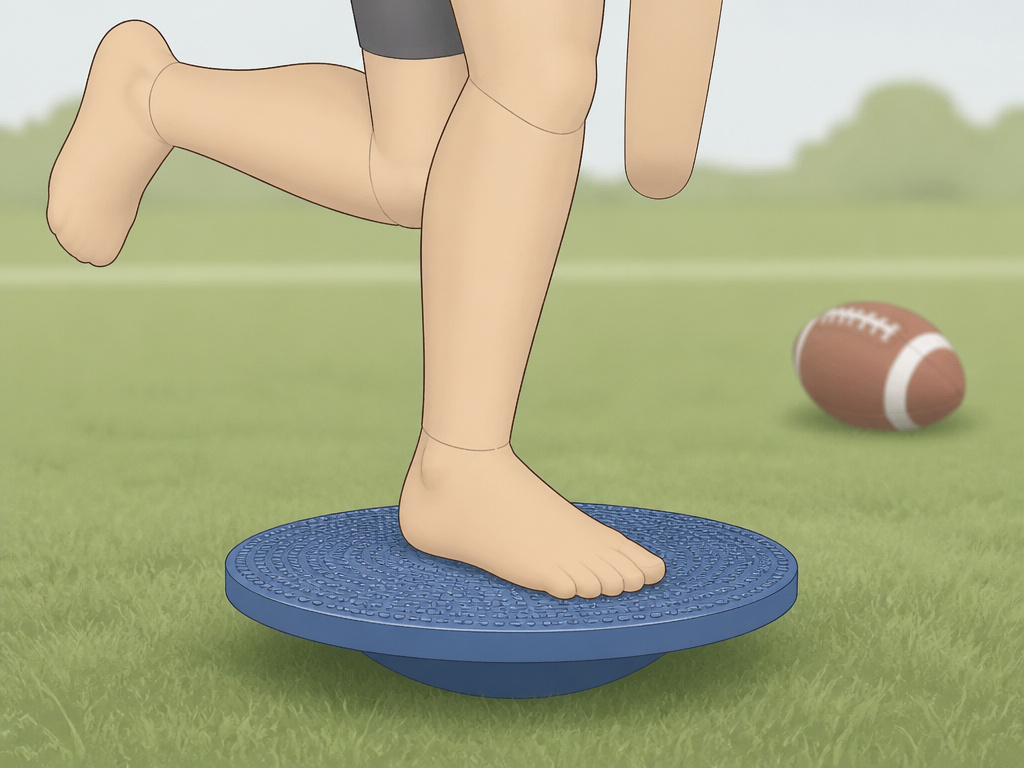
This part is essential. Rest makes the pain go away. Exercise makes the injury go away. The BJSM guideline pulls numbers from ten randomized controlled trials: exercise therapy can reduce the prevalence of recurrent injuries (RR 0.62, 95% CI 0.51 to 0.76). That’s a 38% reduction in relative risk.
It also can reduce the prevalence of functional ankle instability (RR 0.80) and is associated with a quicker time to recovery.
So what’s in this magic exercise therapy? It’s progressive, and it targets the systems that failed.
- Range of Motion (Days 1-7): Alphabet exercises (draw the alphabet with your toe), gentle dorsiflexion stretches. The goal is to fight the stiffness.
- Strengthening (Week 2+): Start with isometrics (pushing against a wall), move to resistance bands for inversion/eversion, then calf raises. The muscles around the ankle are its primary dynamic stabilizers.
- Proprioception & Balance (Week 3+): This is the critical element. Start standing on one leg on the floor, eyes open. Progress to eyes closed, then to an unstable surface (a pillow, then a wobble board). Your brain needs to relearn where your ankle is in space without looking.
- Plyometrics & Sport-Specific Drills (Weeks 4-6+): Hopping in place, then hopping side-to-side and diagonally. Eventually, incorporate light ball work and changes of direction.
Expert Tip: Manual joint mobilisation, hands-on physio techniques, can give a short-term boost in ankle dorsiflexion and decrease pain. The BJSM notes that manual therapy combined with exercise therapy resulted in better outcomes compared with exercise therapy alone. It’s a worthwhile add-on if you have access.
The supervised vs. Unsupervised debate has contradictory evidence. The British Journal of Sports Medicine (BJSM) guideline says supervised therapy may lead to faster return to sport, but many studies show no added effect. Conversely, the Frontiers in Medicine umbrella review states the addition of supervised exercises leads to faster and better recovery. If you’re disciplined, a home program works. If you need accountability and technique checks, a physio is worth it.
The Trivialization Problem in Pro Football
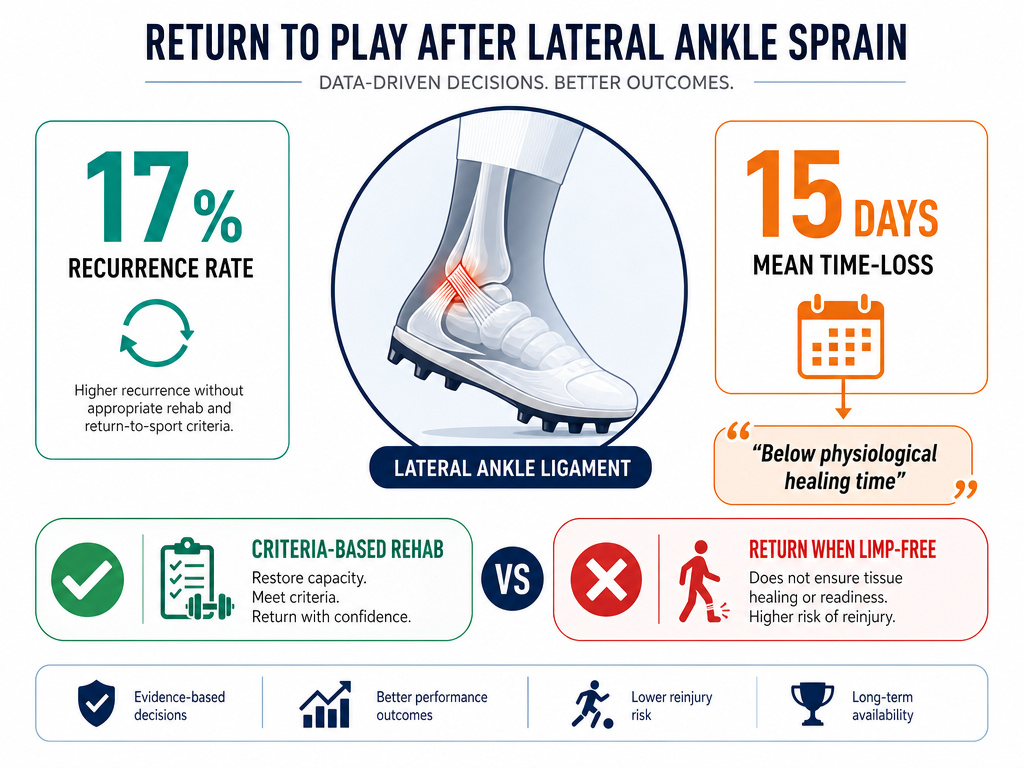
Here’s a statistic that should make any footballer pause: a 2024 clinical commentary in the International Journal of Sports Physical Therapy reported that in professional football, lateral ankle sprains have a recurrence rate of 17% with a mean time-loss of 15 days.
The authors call this out directly. That short time-loss, coupled with a high recurrence rate, “raises the question of trivialization” of LAS in elite footballers. The standard becomes returning as soon as the player can jog without a limp, not when the ligament has healed and the neuromuscular control is restored.
“The average time-loss after LAS in elite football players is 15 days and is thus often below the recovery time required for physiological ligament healing.”
This is the “play through it” culture crashing into medical evidence. A criteria-based rehabilitation approach, where you pass specific strength, balance, and functional tests before advancing, is advocated to get the athlete back safely, not just quickly. For the rest of us, the lesson is clear: don’t use a pro’s 2-week timeline as your benchmark. Their “quick” return might be part of the problem.
Your Football-Specific Return-to-Play Progression
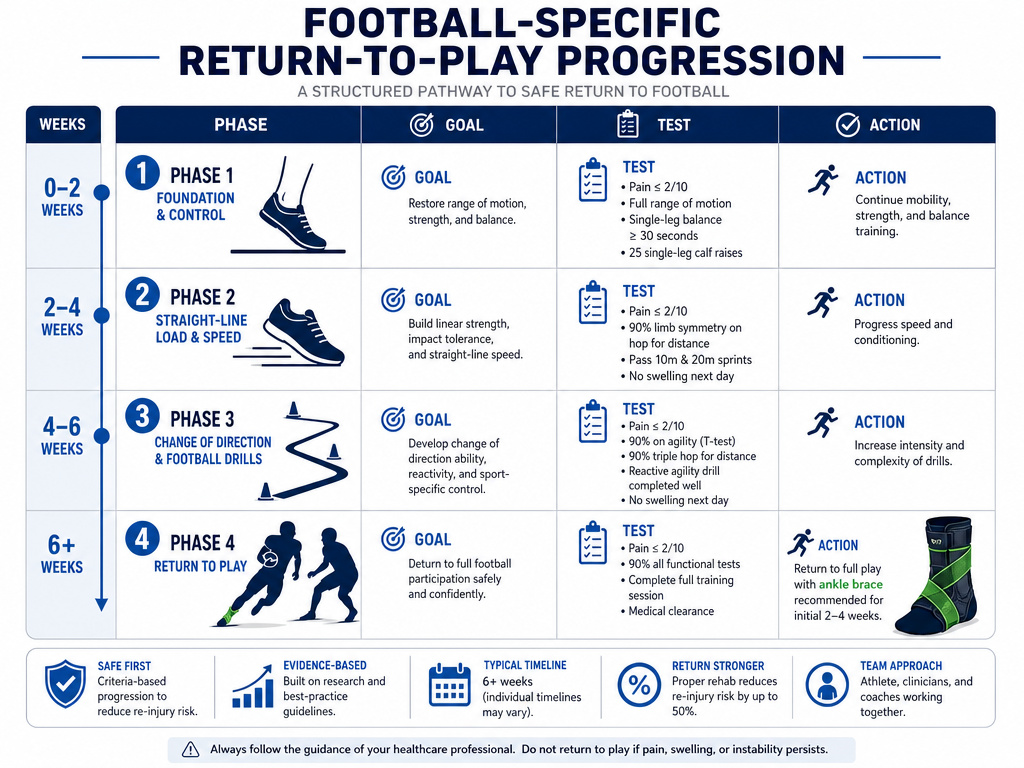
Returning to training is a gradual process like adjusting a dimmer, not an instant change like flipping a switch. This phased approach is what’s missing from most generic guides.
Phase 1: Load Tolerance (Weeks 1-2)
- Goal: Walk normally, pain-free.
- Test: Can you walk normally, pain-free?
- Action: Stationary bike, pool running. No cutting.
Phase 2: Straight-Line Running (Weeks 2-3)
- Goal: Jog, then sprint in a straight line.
- Test: Can you jog and then sprint in a straight line without pain?
- Action: Introduce progressive running drills. Start with jogging intervals.
Phase 3: Change of Direction (Weeks 3-5)
- Goal: Regain confidence in cutting and turning.
- Test: Can you perform a change of direction without hesitation or pain?
- Action: Agility ladder drills, gentle zig-zag runs. Introduce light passing.
Phase 4: Sport-Specific Integration (Weeks 5-6+)
- Goal: Reintegrate full football movements and contact.
- Test: Can you perform sport-specific movements like jumping and light contact stably and without pain?
- Action: Small-sided games (3v3, 4v4), progressing to full training. This is where wearing your ankle brace is mandatory.
This progression is your checklist for ankle sprain from football recovery. Fail a test? You repeat the phase for another 2-3 days. This is the criteria-based model that fights trivialization.
High ankle sprains vs. Lateral sprains
Understanding the type of sprain is key to your recovery plan. The vast majority of ankle sprains in football are lateral sprains, which involve the ligaments on the outside of the ankle. These are the injuries that typically sideline a player for a reported average of 15 days in professional settings. A high ankle sprain is a different and often more severe injury affecting the ligaments connecting the tibia and fibula above the ankle joint. It’s crucial to get an accurate diagnosis, as high ankle sprains generally require a longer and more cautious rehabilitation process. The initial treatment principles of functional support and exercise therapy apply to both, but the specific progression back to cutting and pivoting will differ significantly.
Frequently Asked Questions
How long does it take to recover from a sprained ankle in football?
For a typical Grade II sprain, expect a process guided by functional support for 4–6 weeks and progressive rehabilitation to return to full training and matches. Grade I sprains may have a shorter recovery, while severe Grade III sprains often require a longer rehabilitation process. The timeline is driven by your progression through functional rehab, not just pain.
How do I tell if my ankle sprain is Grade 2 or 3?
You can’t definitively without an MRI, but clues exist. A Grade II (partial tear) usually allows you to bear some weight, albeit painfully, with moderate swelling. A Grade III (complete tear) often involves an immediate inability to bear weight, significant swelling within hours, and sometimes a “popping” sensation at the time of injury. When in doubt, see a doctor or physiotherapist.
What is the hardest football injury to recover from?
While ankle sprains are common, injuries like an ACL tear or a high ankle syndesmosis sprain are generally more complex and have longer, more difficult recoveries (often 9+ months for an ACL). High ankle sprains involve the ligaments between the tibia and fibula and can be especially problematic for pushing off and kicking.
Should I get surgery for a bad ankle sprain?
Almost never as a first option. The British Journal of Sports Medicine guideline reserves surgery for patients with chronic instability after a LAS who have not responded to a full exercise-based physiotherapy programme. It notes that 60-70% of people do well with non-surgical treatment. The guideline adds that in professional athletes, surgical treatment may be preferred to ensure quicker return to play, but this is a point of disagreement; the Frontiers in Medicine umbrella review argues conservative strategies are the best choice given surgical risks and costs.
Before You Go
The one rule most guides skip: if you return to play and your ankle feels “tight” or “not quite right” during your warm-up, stop. That feeling is your proprioceptive system, your internal alarm, telling you it’s not ready. Pushing through that specific sensation is how a 17% recurrence rate happens.
Everything above assumes a standard lateral sprain. If your pain is sharply higher on the front of your ankle between the bones, you might be dealing with a high ankle sprain, a different beast. And this is all guidance, not a substitute for a physio who can put hands on your ankle and tailor the plan. Get the brace, start the exercises on day two, and measure your progress by what you can do, not just what you can’t feel.
