
How to Block a Shot in Football: Key Techniques and Drills
This post contains affiliate links. As an Amazon Associate, we earn from qualifying purchases.
To block a shot in football, defenders must position their body to cut off the shooting angle and commit at the precise moment the attacker winds up, while goalkeepers use specific techniques like the X-block for shots within six metres or set positioning for longer-range efforts. The choice between a block, a tackle, or forcing the attacker wide depends entirely on the defender’s starting position and the goalkeeper’s readiness.
According to FIFA’s Pascal Zuberbühler, the X-block technique is for situations where the attacker is within six metres of the goalkeeper. Get the timing wrong, and the block fails because the attacker has already redirected the shot. This guide explains the timing, the effective body shapes, and the recorded communication failures that can turn a save into a goal, offering a straightforward method for blocking a shot in football.
What follows: the exact techniques for defenders and goalkeepers, the essential rules for their coordination, and three drills you can run this week to turn theory into muscle memory.
Key Takeaways
- The X-block technique is specifically for goalkeepers facing shots from within six metres, according to FIFA’s Pascal Zuberbühler.
- Defenders must communicate intent before attempting a block; a lack of communication between defender and goalkeeper can lead directly to a goal.
- Body shape precedes the block; a goalkeeper must have a strong upper body shape, strong feet and strong hands when making a close-range save.
- Practical drills like the “Block the Shot” game train the unit, not just the individual, making communication instinctive.
What is the X-Block Technique for Goalkeepers?
FIFA’s Senior Goalkeeping Expert, Pascal Zuberbühler, defines the X-block as a core technique for close-range saves, specifically when an attacker is within six metres of the goal. The goalkeeper executes the X-block, spreading arms and legs to maximise coverage of the goalmouth at the exact moment the shot is taken.
The X-block is not a common technique for shots from more than six metres away. For those, a set position and a reactive save are more effective. A goalkeeper must execute the X-block just before the attacker takes his shot. Deploy it too soon, you lose the element of surprise. Deploy it too late, the span of the block isn’t protecting the goal.
The technique’s adoption is exploding. The FIFA Technical Study Group reported a 100% increase in X-block saves at the 2025 FIFA Club World Cup compared to the 2022 World Cup. It’s a technique that has become essential because it reduces the attacker’s visible target in a split second.
Why the six-metre threshold matters: Beyond that distance, the attacker has more time to see the goalkeeper’s shape and adjust their shot placement. The goalkeeper, in turn, has more time to set their feet, read the shooter’s body, and react. Within six metres, it’s a race. The X-block is the goalkeeper’s way of winning that race by attacking the space before the shot even leaves the foot.
Here’s a breakdown of when to use the X-block versus a traditional reactive save:
| Situation | Recommended Technique | Key Reason |
|---|---|---|
| Attacker within 6 metres, ball under control | X-Block | Reduces target size preemptively; attacker has no time to adjust. |
| Attacker beyond 6 metres, shaping to shoot | Set Position & React | Provides time to read shot trajectory and choose save type (dive, spread, parry). |
| Attacker dribbling, not yet in shooting motion | Stay on feet, narrow angle | Maintains adaptability; committing to an X-block too early allows a dribble past. |
The most common mistake is misjudging that distance. You see a keeper launch into an X-block from ten yards out, and the striker just calmly slots it to the side. It looks like a bad read. It is a bad read. The distance dictated the wrong technique.
Defender Positioning and Body Shape for Blocking
A block from a defender isn’t about throwing your body in front of the ball. It’s about constructing a wall where the attacker least wants it. Your positioning and shape minutes before the shot matter more than the heroic lunge when mastering how to block a shot in football.
Communication Between Goalkeeper and Defender
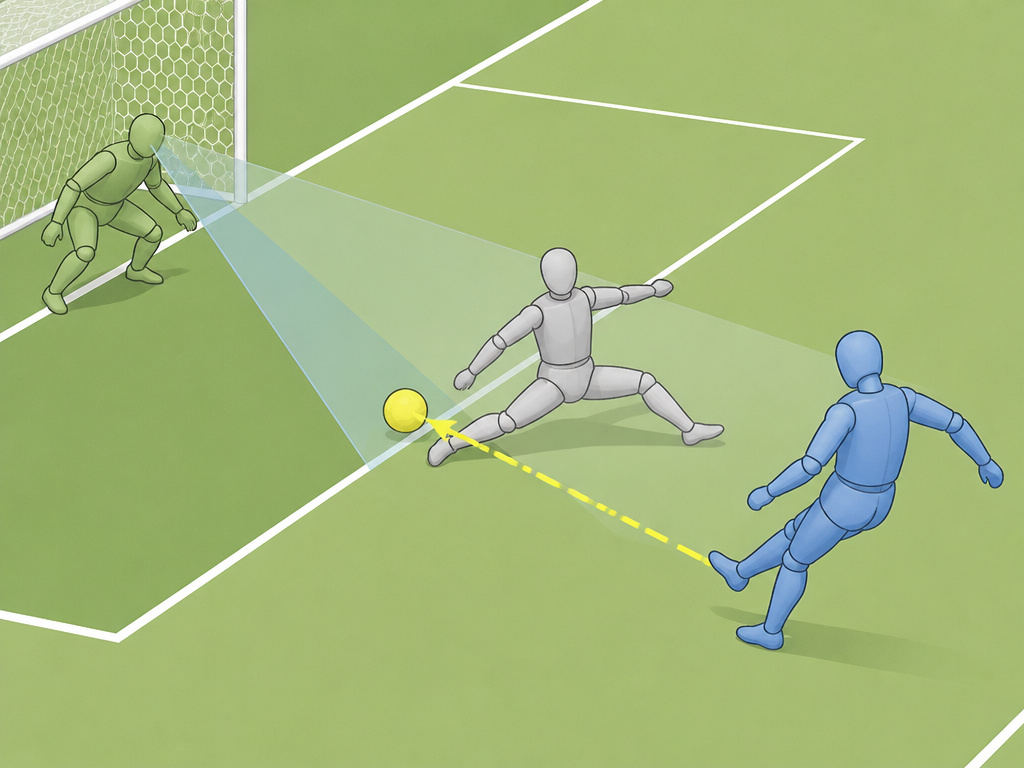
A blocked shot in a crowded penalty area is a coordinated act, not two individuals working in isolation, which is central to how to block a shot in football. When it fails, you often find a communication breakdown at the heart of it.
A lack of communication between defender and goalkeeper can lead directly to a goal, as analysis from Tactics Journal indicates communication is vital.
Communication between defender and goalkeeper is vital for blocking shots. Tactics Journal analysis suggests responsibilities are shared: a defender can block one post while the goalkeeper covers the other, but the goalkeeper cannot fully commit 100% to one post because the defender might not get a solid block.
Common mistake: A defender blocking the goalkeeper’s sightline by standing directly between them and the shooter. The FIFPlay blog advises defenders to stay slightly off-center. This gives the keeper a clear view of the ball and the attacker’s striking foot, shaving crucial milliseconds off their reaction time.
Close-Range Shot Stopping: Data and Techniques
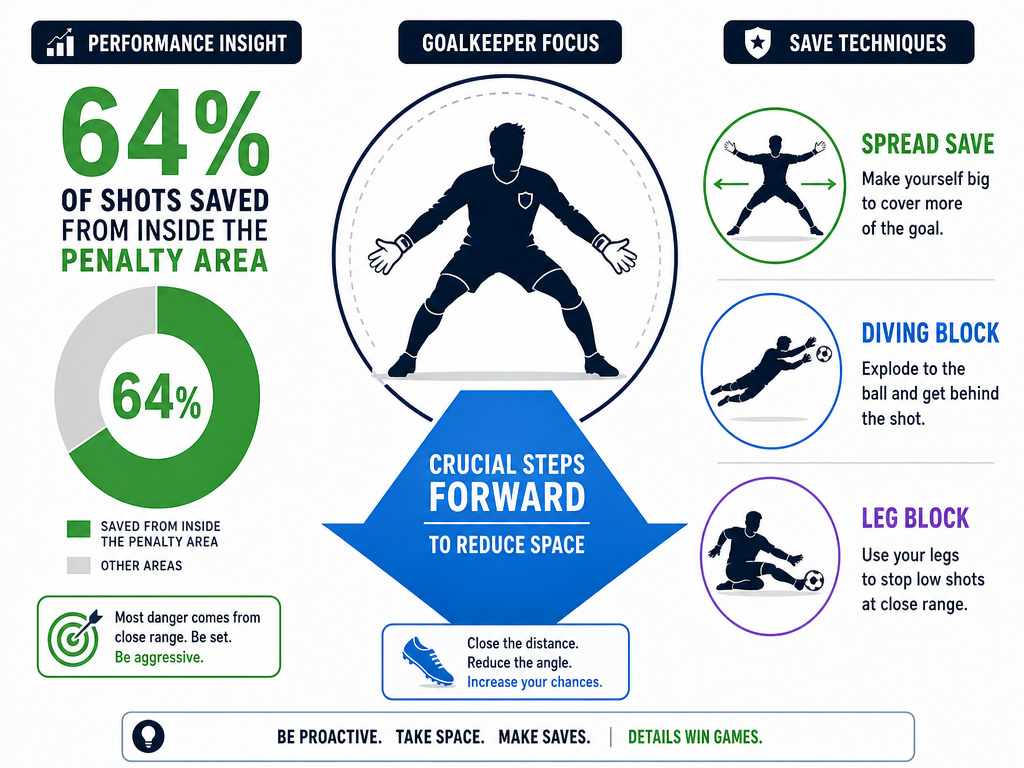
The data reveals a surprising truth: goalkeepers are remarkably effective at close range. Up to the semi-finals of the men’s Olympic Football Tournament 2024, goalkeepers saved 64% of attempts on target from inside the penalty area. Four goalkeepers at that tournament had save rates of 75% or more in those situations.
The technique driving these numbers isn’t just miraculous reflexes. It’s a calculated, aggressive reduction of space. As Pascal Zuberbühler notes, in a 1v1 situation where defenders can’t help, the goalkeeper must take crucial steps forward. By moving closer, the goalkeeper makes himself bigger and the goal smaller. The attacker’s margin for error vanishes.
This requires a specific physical toolkit: a strong upper body shape, strong feet, and strong hands.
For shots that aren’t suitable for the X-block, goalkeepers have techniques outlined by the FIFPlay blog, including spread saves for close-range shots, diving blocks when a shot is placed far from reach, and leg blocks for quick shots from close range.
Practical Drills for Improving Shot Blocking
Theory is useless without the burn in your legs and the timing in your bones. These drills move from individual technique to unit coordination.
1. The Reactive Square (For Goalkeepers)
2. Bent-Knee Block Drill (For Defenders)
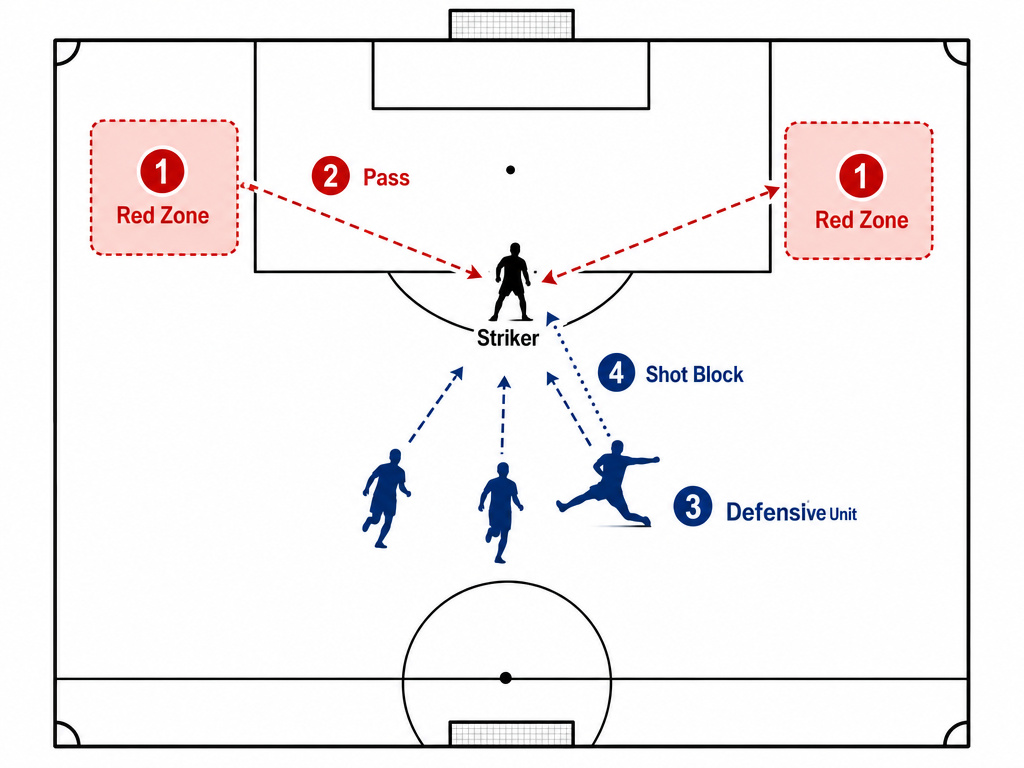
3. “Block the Shot” Team Drill
- Execution: Attackers try to score, but can only take first-time shots from the red zones or from a pass originating there. Defenders must communicate, close down space as a unit, and focus on getting blocks on every shot. Points are awarded for blocked shots and clean defensive phases.
- Focus: Unit communication and collective decision-making under fatigue. It forces defenders to talk, to cover for each other, and to think about recovery after a block. This is the live-fire exercise for organized defending principles.
What counts as a blocked shot?
A blocked shot is any goal-bound attempt stopped by a defender or goalkeeper before it reaches the goal line. This action is a key defensive metric, often tracked as a ‘save’ for goalkeepers. For example, at a recent major tournament, goalkeepers saved a significant majority of attempts on target from inside the penalty area. Statistical analysis shows the effectiveness of specific blocking techniques, with the use of one advanced close-range method doubling in frequency at the highest levels of club competition over a short period.
How acceleration and agility improve shot blocking
For a goalkeeper, explosive acceleration off the line is critical for closing down an attacker in a one-on-one situation. Moving forward quickly makes the goalkeeper bigger and the target smaller. Agility allows for rapid adjustments in footwork to get into a strong, set position just before the shot. This combination of fast, short bursts and nimble movement is essential for executing techniques like the spread save or the X-block at the precise moment needed to be effective.
Frequently Asked Questions
What is a shot block in football?
Shot block is a defensive action where a player (usually a defender or goalkeeper) uses their body to prevent an opponent’s shot from reaching the goal. It is distinct from a save, as it often involves a deflection or interruption before the shot is on its full trajectory towards the net.
What is the best way to block in football?
The best way depends on your position. For defenders, it’s to delay the attacker, show them into a crowded area, and then use a balanced, square body shape with a bent-knee technique to deflect the shot. For goalkeepers, it’s to judge the distance—using the X-block within six metres or a set, reactive position for longer shots—and attack the space to make yourself big.
How to block shots as a defender?
Get goal-side first. Match the attacker’s run. As they prepare to shoot, don’t lunge. Instead, get low with a wide base, chest square to the shooter. Time your movement so your body is interposed at the moment they strike the ball. Aim to deflect the ball to a safe area with your shin or foot, not just stop it dead at your feet.
How to block correctly?
Correct blocking is about technique and timing, not just bravery. It requires proper body shape (square, balanced), precise timing (committing as the shooter winds up), and a clear objective (deflect to safety, not just stop). For goalkeepers, it also mandates strict adherence to distance-based techniques like the six-metre rule for the X-block.
Before You Go
Watch a full match this week, but ignore the ball for ten-minute stretches. Watch the defenders. Watch the space between the goalkeeper and the back line. You’ll start seeing the blocks before they happen—the subtle shift in a defender’s stance that says “I’m channeling you here,” or the goalkeeper’s tiny forward creep that shrinks the angle by a crucial degree.
The one drill to run at your next training session is the “Block the Shot” team game. It’s noisy, it’s chaotic, and it forces the talking that doesn’t happen in silent drills. If you can block as a coordinated unit when you’re tired and under pressure, you can do it when it matters.
And remember the lesson from that Iceland goal: a block attempted is a responsibility claimed. If you’re going to step in, own it completely. Your teammates are counting on you to either get the ball or make the play so clear they can cover for you. Anything in between is how goals happen.
